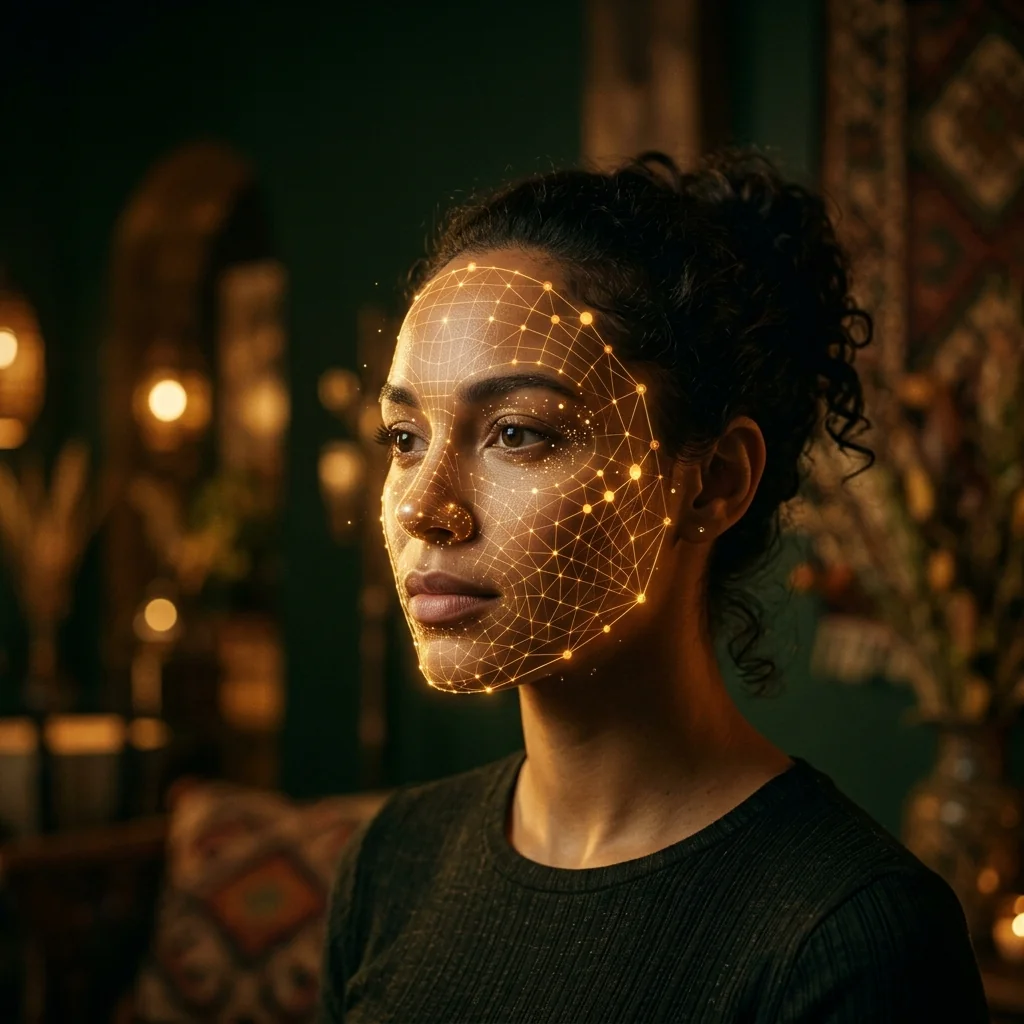
A repeatable way to check consistency without claiming accuracy
No independently published validation study or numerical ancestry-accuracy benchmark for Ancestor Lens was supplied for this guide. A polished report, a percentage or a repeated label does not establish that the output corresponds to a person's genetic ancestry.
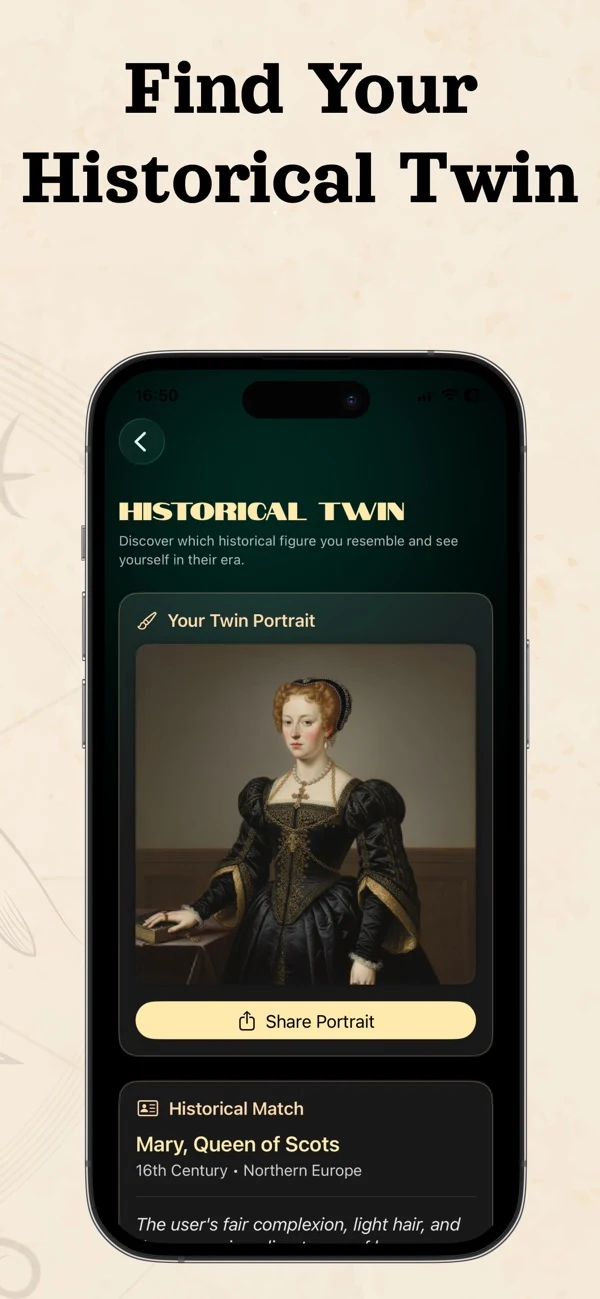
- Portrait: this is a creative visual output.
- Historical name: a look-alike label does not prove descent from that person.
- Explanation: apparent plausibility is not a scientific validation of ancestry.
Published App Store screenshot, checked October 13, 2026; view the source listing. It documents the advertised interface, not independently tested accuracy.
- Use two clear, unfiltered photos of yourself with similar light, angle and framing.
- Record the feature, app version, exact labels and scores for each result.
- Compare what stays the same and what changes. Do not choose a result only because it fits a hoped-for family story.
- Keep the observations as a consistency check. Without an appropriate validation study, they cannot produce an accuracy percentage.
For family-history questions, use documented genealogy and appropriate genetic evidence. For visual exploration, read how to use and read a photo-based report, how to interpret ethnicity labels and why nationality cannot be identified from a face.
AI ethnicity tests have become one of the most popular ways to explore ancestry online. Instead of sending saliva to a laboratory and waiting several weeks, you upload a photo and receive an instant ancestry-style result.
But how accurate are AI ethnicity tests? Can an app really identify your ancestry from your face?
The most important answer is this:
An AI ethnicity test can identify visual resemblance patterns, but it cannot determine your biological ancestry or replace a DNA test.
That does not make the experience meaningless. It simply means the result needs to be interpreted correctly.
What Is an AI Ethnicity Test?
An AI ethnicity test is a visual analysis tool that examines a photograph of your face and compares visible facial patterns with patterns learned from large image datasets.
Depending on the system, the analysis may consider:
- Overall face shape
- Facial proportions
- Eye and eyebrow structure
- Nose shape
- Jawline and chin
- Cheekbone structure
- The relative position of facial landmarks
- Visual similarities associated with different geographic regions
The app then generates an ancestry-style interpretation showing the countries, regions, or population groups your appearance may resemble.
Unlike a DNA test, it does not analyze your genes.
How Does an AI Ethnicity Test Work?
Photo-based AI tools generate an interpretation from visible image information. The specific model, training data and validation methods for Ancestor Lens are not documented in this website repository.
A general explanation of computer vision should not be taken as a verified description of this app’s implementation. Use the displayed report as visual exploration rather than evidence of a genetic lineage.
The report is a generated visual interpretation. Its scores are not established scientific probabilities of ancestry.
It is not based on:
- Your chromosomes
- Genetic markers
- Family records
- Citizenship
- Place of birth
- Your parents’ nationality
This distinction explains both the value and the limitations of the technology.
Can AI Determine Your Real Ethnicity From a Photo?
A photograph cannot establish ethnicity, genetic ancestry or nationality.
Ethnicity is not simply a facial category. It may include ancestry, culture, language, nationality, family history, community, and personal identity.
People from different populations can share similar facial features. At the same time, people from the same family or geographic region can look very different.
Centuries of migration and intermarriage have also distributed physical traits across large parts of the world.
For example, features commonly associated with the Mediterranean may appear among people with family roots in:
- Southern Italy
- Greece
- Türkiye
- Spain
- Portugal
- The Balkans
- North Africa
- The Levant
An AI tool may recognize this broad visual pattern, but it cannot prove which specific country appears in your family tree.
AI Ethnicity Test vs DNA Test
AI analysis and DNA testing answer different questions.
An AI ethnicity test asks:
“What populations or regions does my appearance visually resemble?”
A DNA ancestry test asks:
“What genetic populations are represented in my DNA?”
A laboratory DNA test examines genetic variants inherited from biological relatives. It can provide evidence about genetic ancestry, although DNA ethnicity percentages are also estimates and may change when a testing company updates its reference database.
An AI face test does not examine inherited genetic markers. It offers a fast, visual, and entertainment-focused way to explore possible heritage patterns.
| AI ethnicity test | DNA ancestry test |
|---|---|
| Uses a photograph | Uses saliva or another biological sample |
| Produces instant results | Usually requires several weeks |
| Analyzes visual resemblance | Analyzes genetic markers |
| Intended for exploration and entertainment | Intended for genetic ancestry research |
| Cannot verify biological relationships | May identify genetic relatives |
| No laboratory kit required | Requires laboratory processing |
The two experiences can complement each other, but they should not be treated as equivalent.
Why Can Two Apps Give Different Results?
Different AI ancestry apps may produce different answers because they do not all use the same:
- Training datasets
- Regional categories
- Facial analysis models
- Image quality requirements
- Scoring systems
- Country and population definitions
One app may group a visual pattern under “Southern European,” while another may divide it into Italian, Greek, Iberian, or Balkan categories.
The result can also change depending on the photograph you upload.
Lighting, camera angle, facial expression, makeup, filters, shadows, and image resolution may all affect which facial landmarks the system detects.
Why Might Siblings Receive Different Results?
Siblings inherit different combinations of traits from their parents.
One sibling may have a parent’s eye shape and the other may inherit a grandparent’s jawline or nose structure. Even identical family backgrounds do not guarantee identical facial appearance.
An AI test analyzes what is visible in a particular image. It does not know that two people are siblings unless that information is explicitly provided.
Different results therefore do not necessarily mean that one result is “wrong.” They may reflect the different visual characteristics expressed by each person.
What Makes an AI Ethnicity Result More Reliable?
Although an AI result cannot become a genetic diagnosis, you can improve the consistency of the visual analysis.
Use a photo that has:
- One person only
- A front-facing angle
- Natural, even lighting
- A neutral expression
- No sunglasses
- No strong beauty filter
- No face-obscuring hair
- No extreme camera distortion
- A clear view of the entire face
- Sufficient image resolution
Avoid group photos, side profiles, dark rooms, dramatic shadows, screenshots, and heavily edited images.
You can also try two or three clear photographs. If similar regional patterns repeatedly appear, the visual interpretation may be more consistent.
How Should You Interpret the Percentages?
An AI ancestry percentage should not be read as a literal genetic percentage.
For example, a result showing “42% Greek” does not mean that 42% of your DNA is Greek. It means the system detected a relatively strong visual resemblance to patterns categorized as Greek within that particular model.
The percentages are best understood as a distribution of visual similarity.
A more responsible interpretation would be:
“My features received the strongest visual match with Greek and Southern Italian reference patterns.”
This is different from saying:
“I am genetically 42% Greek.”
Why Can an Unexpected Result Feel Accurate?
People often receive results connected to a region they did not expect. Sometimes a family member then remembers a migration story, a grandparent’s birthplace, or an unknown branch of the family tree.
In other cases, the result may simply reflect facial similarities shared across neighboring populations.
Unexpected results are useful as conversation starters. They can inspire you to:
- Ask relatives about family history
- Examine old photographs
- Search birth and marriage records
- Build a family tree
- Learn about migration routes
- Compare the result with known family origins
- Take a DNA test when scientific evidence is needed
The AI result should be the beginning of a question, not the final proof.
Are AI Ethnicity Tests Biased?
Any AI system can reflect limitations in its training data.
If some populations are represented by fewer or less diverse images, the model may produce less consistent results for those groups. Categories can also oversimplify populations with extensive internal diversity.
A responsible ancestry app should therefore avoid claiming that facial appearance proves ethnicity, nationality, race, or biological lineage.
Results should be presented as visual estimates and entertainment, not as official identity classifications.
Is an AI Ancestry Test Worth Trying?
An AI ancestry test can be worth trying when you understand what it offers.
It is useful for:
- Exploring how your features may be perceived
- Starting a conversation about family history
- Comparing visual resemblance with relatives
- Creating shareable ancestry content
- Discovering historical or regional look-alikes
- Satisfying curiosity without ordering a DNA kit
It is not suitable for:
- Proving ethnicity
- Confirming citizenship
- Establishing biological relationships
- Making medical conclusions
- Verifying a legal identity
- Replacing genealogical or genetic research
Try a Visual Ancestry Analysis
Ancestor Lens offers an instant, photo-based way to explore regional resemblance, face heritage, and historical visual connections.
Upload a clear selfie and discover which ancestry-style patterns your features may resemble.
No DNA kit or laboratory wait is required.
Frequently Asked Questions
Are AI ethnicity tests accurate?
AI ethnicity tests can detect visual resemblance patterns, but they cannot scientifically verify ethnicity or biological ancestry. Their results should be treated as estimates for exploration and entertainment.
Can an AI tell my nationality from my face?
No. Nationality is a legal and cultural identity that cannot be determined from facial appearance. AI can only suggest countries or regions associated with visually similar patterns.
Is an AI ethnicity percentage the same as a DNA percentage?
No. An AI percentage represents visual similarity within the app’s model. A DNA percentage is an estimate based on genetic markers and reference populations.
Why did my AI ancestry result change with another photo?
Lighting, angle, facial expression, filters, image quality, and camera distortion can change how facial landmarks are detected.
Can an AI ancestry test reveal unknown family origins?
It may suggest regions worth exploring, but it cannot confirm an unknown ancestor. Family records, genealogy research, and DNA testing are needed for stronger evidence.
Is Ancestor Lens a DNA test?
No. Ancestor Lens is a visual ancestry and entertainment experience. It does not analyze DNA or prove biological lineage.
Explore More
- AI Face Ethnicity Test: Discover Your Face Heritage with AI
- DNA Test vs AI Ancestry Analysis: What Is the Difference?
- What Country Do My Facial Features Come From?
- How to Find Your Heritage Without a DNA Test
- Is AI Ancestry Safe? What Happens to Your Photo
Discover Your Face Heritage with Ancestor Lens
Ready to see what country your facial features may resemble? Try Ancestor Lens and discover your face heritage instantly. No DNA required.