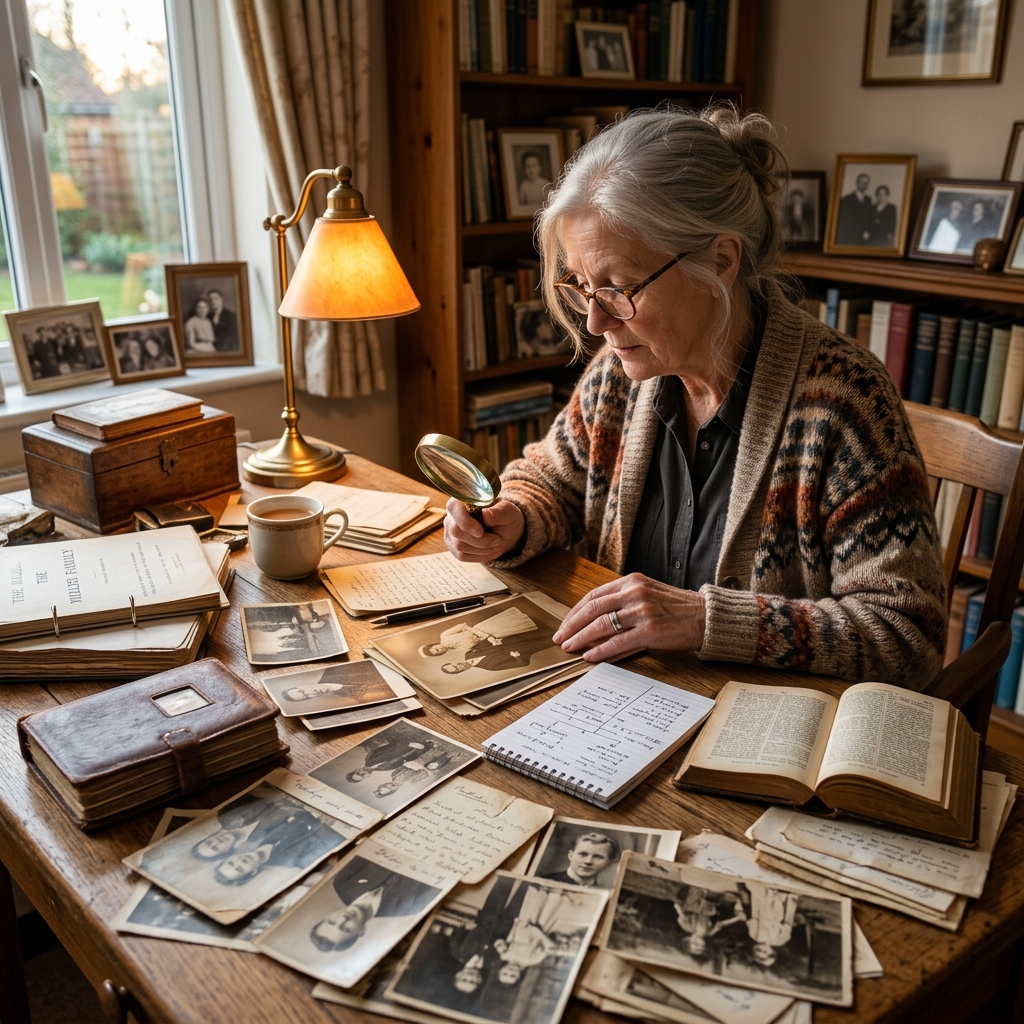
An unexpected ancestry result can create more questions than answers.
Perhaps an AI photo analysis suggested a region you had never considered. Maybe the result reminded you of a family story, an old surname, or a relative whose origins were never fully explained.
A visual result cannot prove your genetic ancestry, but it can inspire a meaningful next step: researching your family history.
This beginner-friendly guide explains how to move from curiosity to evidence using relatives, documents, photographs, archives, and, when appropriate, DNA testing.
Start With What You Already Know
Before searching online, write down the information already available in your family.
Begin with yourself and work backward:
- Your full name and birth date
- Your parents’ names and birthplaces
- Your grandparents’ names and birthplaces
- Marriage dates
- Places where relatives lived
- Languages spoken in the family
- Religious or cultural traditions
- Family surnames and previous spellings
- Known migrations
- Military service
- Occupations
Do not worry if some details are incomplete. The goal is to create a starting framework.
Separate Facts From Family Stories
Family stories are valuable, but they may change as they pass from one generation to another.
Create two columns:
Confirmed information
Information supported by documents, photographs, official records, or several independent sources.
Unconfirmed family stories
Stories that may be true but still require evidence.
For example:
- “Our great-grandfather came from Italy.”
- “The family surname was changed at the border.”
- “We may have Armenian relatives.”
- “A branch of the family moved from Poland to Germany.”
- “Our grandmother said her mother was adopted.”
These stories are excellent research clues, but they should not immediately be treated as established facts.
Talk to the Oldest Relatives First
Older relatives may remember people, places, nicknames, traditions, or events that were never written down.
Ask open questions rather than questions that suggest an answer.
Good questions include:
- What were your parents’ full names?
- Where were they born?
- What language did they speak at home?
- Did the family move from another country or region?
- Which relatives lived nearby?
- Were any surnames changed?
- What traditions did the family celebrate?
- Do you remember the names of your grandparents?
- Are there old letters, certificates, or photographs?
- Who in the family knew the most about our history?
Record the conversation with permission or take detailed notes.
Dates may be slightly inaccurate, so verify important details later.
Collect Family Documents
Search family homes, storage boxes, albums, and digital folders for documents such as:
- Birth certificates
- Marriage certificates
- Death certificates
- Passports
- Immigration papers
- Naturalization records
- School certificates
- Military documents
- Religious records
- Property papers
- Letters and postcards
- Funeral notices
- Family Bibles
- Old address books
Even a small detail can unlock the next stage of research.
A witness name on a marriage certificate might reveal a sibling. A handwritten address on a postcard may identify a hometown. A passport may show an older spelling of the family surname.
Label Old Family Photographs
Unlabeled photographs quickly lose their historical value.
For every image, record as much as possible:
- Full names
- Approximate year
- Location
- Relationship to you
- Occasion
- Photographer or studio
- Notes written on the back
- Who identified the people
Ask several relatives independently when possible. One person may remember a face that another does not.
Scan important photographs and store copies in more than one location.
Build a Simple Family Tree
You do not need advanced genealogy software to begin.
Start with a basic tree showing:
- Yourself
- Your parents
- Your grandparents
- Your great-grandparents
For each person, record:
- Full name
- Alternative name or spelling
- Birth date and place
- Marriage details
- Death date and place
- Parents
- Spouse or spouses
- Children
- Sources supporting the information
Always record where each fact came from. A family tree without sources can easily accumulate mistakes.
Search One Person at a Time
A common beginner mistake is searching for an entire family story at once.
Instead, choose one specific person and one specific question.
For example:
- Where was Maria Kowalska born?
- Who were the parents of Samuel Cohen?
- When did Antonio Rossi arrive in the United States?
- Was Anna Schmidt’s surname changed after marriage?
- Which village did my great-grandfather come from?
A focused question makes it easier to select the correct records and avoid confusing people with similar names.
Expect Different Spellings
Names often change across languages, alphabets, borders, and administrative systems.
A surname may have been:
- Translated
- Shortened
- Written phonetically
- Adapted to a new alphabet
- Changed after marriage
- Recorded incorrectly
- Simplified during immigration
Search multiple spelling variations.
Also remember that historical borders changed. A town that is now in Ukraine, Poland, Austria, Germany, Turkey, Greece, Armenia, or another modern country may have belonged to a different state when your ancestor was born.
Search by town or region as well as by modern country.
Use Location Before Assumptions About Ethnicity
Official records often identify a birthplace, residence, language, religion, or citizenship, but those details do not always correspond neatly to modern ethnic categories.
A person born in one empire may have spoken another language, belonged to a minority community, and later become a citizen of a different country.
Avoid forcing historical identities into modern national labels too quickly.
Focus first on documented locations, names, relatives, communities, and migrations.
Look for Vital and Religious Records
Birth, marriage, and death records are central sources in family history research.
Depending on the country and period, useful records may be held by:
- Civil registration offices
- Churches
- Synagogues
- Mosques
- Municipal archives
- Regional archives
- National archives
- Historical societies
Religious records may predate civil registration and can include baptisms, marriages, burials, witnesses, godparents, and family relationships.
Access rules vary by country, record type, and date.
Explore Census and Residence Records
Census, household, and residence records may reveal:
- Family members living together
- Ages
- Birthplaces
- Occupations
- Languages
- Citizenship
- Immigration status
- Addresses
- Relationships within the household
Compare records from different years. A change in address, occupation, household members, or recorded birthplace may provide a new clue.
Remember that historical records can contain mistakes.
Investigate Migration Records
When a family crossed borders, look for:
- Passenger lists
- Border records
- Visa applications
- Naturalization files
- Alien registration documents
- Refugee records
- Employment permits
- Foreign resident registrations
Do not assume the place of departure was the ancestor’s birthplace. A passenger may have departed from a major port far from their home region.
Naturalization records can sometimes provide more precise birthplaces than passenger lists.
Use Historical Maps
Modern maps may not show old village names, districts, or borders.
Historical maps can help you understand:
- Which country controlled a location at the time
- Nearby towns and religious communities
- Alternative place names
- Administrative districts
- Migration routes
- Changes caused by war or border agreements
When a record contains an unfamiliar place, search for spelling variants and names in other languages.
Treat Online Family Trees as Clues
Public family trees can be helpful, but they may contain copied mistakes.
Before adding information from another tree, check:
- Does it cite original records?
- Are the dates geographically possible?
- Are spouses and children consistent?
- Could two people with the same name have been combined?
- Does the source actually refer to the correct person?
Use online trees to discover potential leads, not as automatic proof.
When Can DNA Testing Help?
DNA testing may help when you want to explore genetic ancestry or identify biological relatives.
It may be useful for:
- Confirming connections between family branches
- Finding genetic matches
- Investigating unknown parentage
- Supporting documentary research
- Exploring broad genetic ancestry estimates
However, DNA results require careful interpretation. Ethnicity estimates can differ between companies and may change as reference databases are updated.
Before testing, consider privacy, data storage, family consent, and the possibility of discovering unexpected relationships.
How Does an AI Ancestry Result Fit Into Research?
An AI ancestry result should be treated as inspiration, not evidence.
It may encourage questions such as:
- Why does this region keep appearing?
- Do we have relatives from a neighboring area?
- Could an old family story relate to this result?
- Which side of the family shares these facial features?
- Are there migration connections between the suggested regions?
But do not add a country or ethnicity to your family tree solely because an app suggested it.
A family history conclusion should be supported by documents, reliable testimony, archival evidence, or appropriate genetic research.
Create a Research Log
A research log prevents you from repeating the same searches and losing useful information.
For every search, record:
- Date
- Person researched
- Question
- Website or archive
- Search terms
- Records found
- Records not found
- New clues
- Next action
Negative results are useful too. Knowing that a person was not found in one location or database can help narrow the search.
Verify Every Generation Before Moving Back
It is tempting to connect your family to a famous historical person, noble line, royal family, or ancient population.
Move slowly.
Confirm the relationship between each generation before moving to the previous one. A tree is only as reliable as its weakest connection.
The most valuable family history is not necessarily the oldest or most dramatic. A well-documented story about an ordinary great-grandparent is more meaningful than an unsupported connection to royalty.
A Beginner’s Family History Checklist
Use this order:
- Write down what you know.
- Interview relatives.
- Collect certificates and photographs.
- Build a basic sourced family tree.
- Choose one unanswered question.
- Search relevant records.
- Check spelling and location variants.
- Compare several sources.
- Record your searches.
- Use DNA only when it supports your research goal.
- Treat AI visual results as inspiration rather than proof.
- Share and preserve what you discover.
Turn Curiosity Into a Family Story
Ancestor Lens can be the first playful step in exploring visual heritage and family resemblance.
An unexpected result might encourage you to call a relative, open an old photograph album, investigate a surname, or finally document stories that have been passed down for years.
The app cannot replace records, genealogy research, or DNA evidence. But curiosity often begins with a simple question:
“Where might this part of my story come from?”
Use that question to begin a thoughtful, evidence-based journey into your family history.
Discover Your Face Heritage with Ancestor Lens
Ready to see what country your facial features may resemble? Try Ancestor Lens and discover your face heritage instantly. No DNA required.