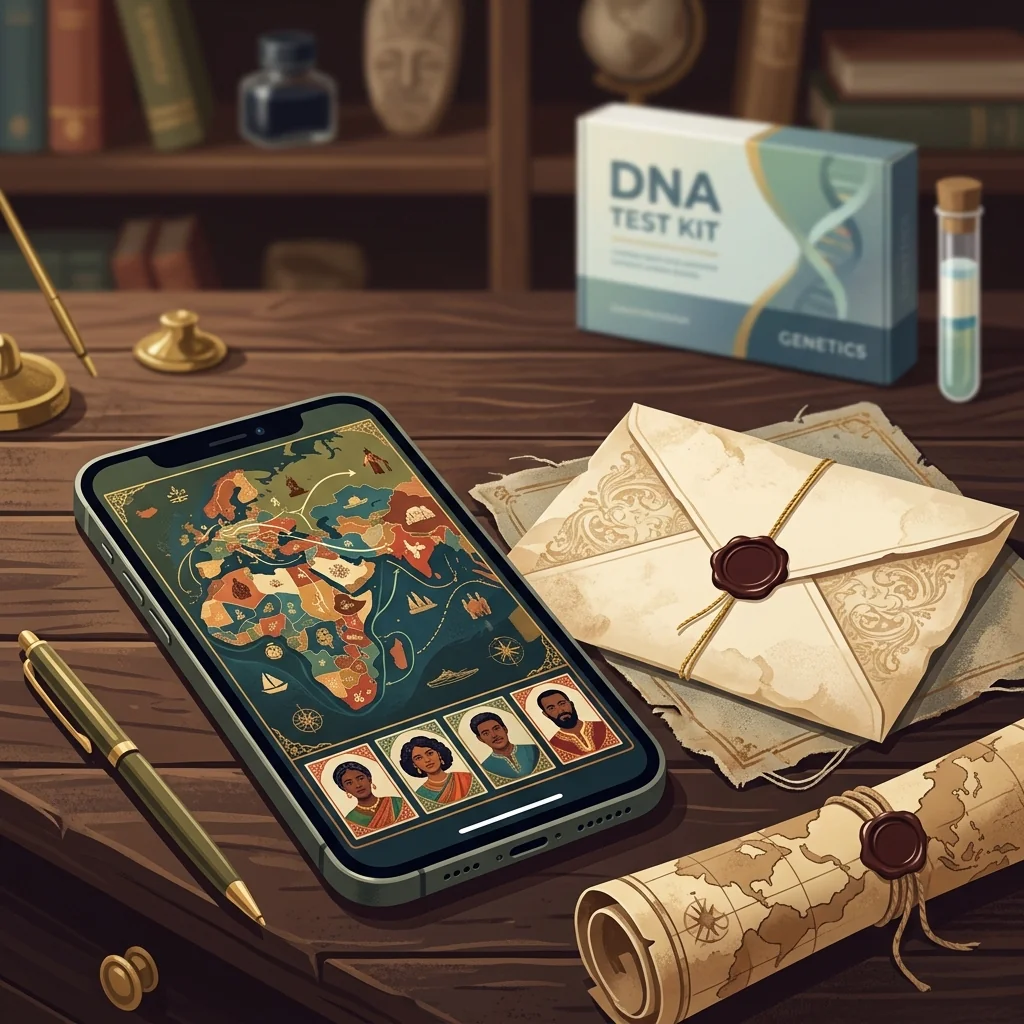
You do not always need a DNA kit to begin exploring your ancestry.
Today, ancestry apps can help you examine family records, organize a family tree, investigate surnames, compare old photographs, explore regional history, or receive an AI-powered visual ancestry result from a selfie.
Each type of app answers a different question.
Some help you research documented relatives. Others focus on appearance, cultural heritage, historical resemblance, or family storytelling.
This guide explains the main types of ancestry apps available without a DNA test and how to choose the right experience.
Can You Discover Your Ancestry Without DNA?
Yes, but the type of information you discover depends on the method you use.
Without DNA, you can explore ancestry through:
- Birth, marriage, and death records
- Census documents
- Immigration and passenger lists
- Church registers
- Family photographs
- Oral family stories
- Surnames
- Geographic history
- Public archives
- AI face analysis
- Historical look-alike tools
None of these methods alone can provide a complete genetic ancestry profile.
However, they can reveal useful clues and help you decide which parts of your family history you want to investigate further.
The Main Types of Ancestry Apps
There is no single “best” ancestry app for every user.
The right choice depends on whether you want instant visual discovery, detailed genealogy research, a family tree, surname information, or a creative historical experience.
1. AI Face Ancestry Apps
Best for: instant visual exploration and shareable results.
An AI face ancestry app analyzes a selfie and suggests countries, regions, historical profiles, or population patterns your appearance may resemble.
These apps may evaluate visual characteristics such as:
- Face shape
- Eye structure
- Nose shape
- Cheekbones
- Jawline
- Facial proportions
- Relative landmark positions
The main advantage is speed. You can receive a result within moments without sending a biological sample to a laboratory.
AI ancestry apps are useful when you want to:
- Explore how your features may be perceived
- Compare results with relatives
- Find a historical look-alike
- Create ancestry content for social media
- Begin a conversation about family origins
- Try an ancestry experience without a DNA kit
However, visual analysis cannot confirm biological ancestry. The result represents resemblance, not genetic proof.
Ancestor Lens belongs to this category. It provides a visual ancestry and historical discovery experience from a photograph.
2. Family-Tree Apps
Best for: organizing known relatives and family connections.
Family-tree apps help you create a structured map of your family.
You can usually add:
- Parents
- Grandparents
- Great-grandparents
- Birth dates
- Marriage information
- Locations
- Photographs
- Documents
- Family stories
This type of app is useful when your relatives already know a significant amount about the family.
Its accuracy depends on the information you enter. A family tree does not automatically verify every relationship, so documents and reliable sources remain important.
3. Genealogy Record Apps
Best for: evidence-based family-history research.
Genealogy platforms provide access to historical records that may include:
- Census data
- Birth certificates
- Marriage records
- Death records
- Military files
- Immigration documents
- Newspaper archives
- Passenger lists
- Church records
These services can be extremely useful, but the process takes time. Names may be misspelled, borders may have changed, and several people may share the same date and place of birth.
Record-based research is strongest when each connection is supported by more than one source.
4. Surname-Origin Apps
Best for: learning about the possible history and distribution of a family name.
Surname tools may show:
- Where a surname is most common
- Historical spelling variations
- Language of origin
- Occupational meanings
- Migration patterns
- Regional distribution
A surname can provide an interesting clue, but it does not describe your complete ancestry.
Names change through marriage, adoption, immigration, translation, transliteration, and administrative errors. One surname also represents only one line among many family branches.
5. Historical Look-Alike Apps
Best for: visual storytelling and entertainment.
Historical look-alike tools connect a modern face with historical portraits, eras, archetypes, or ancestry-inspired characters.
A result might suggest that your appearance resembles:
- A Renaissance portrait
- An ancient Mediterranean profile
- A Celtic-inspired face
- A medieval noble
- An Eastern European historical type
- A Balkan or Middle Eastern regional profile
These experiences do not prove that you are related to a historical person. Their purpose is to combine facial resemblance, history, and imagination.
They can be especially engaging when used with old family photos.
6. Family Photo and Restoration Apps
Best for: preserving visual family history.
Photo apps can help you:
- Restore damaged photographs
- Improve faded images
- Colorize black-and-white portraits
- Organize family albums
- Compare facial resemblance
- Add dates, names, and locations
- Share archives with relatives
These tools may not estimate ancestry directly, but they can reveal meaningful family connections.
A restored photograph can also encourage older relatives to recall names, places, and stories that were never formally documented.
7. Cultural Heritage Apps
Best for: exploring traditions connected to a country or region.
Cultural heritage tools may include information about:
- Traditional food
- Languages
- Music
- Festivals
- Clothing
- Folklore
- Historical migrations
- Regional customs
- Religious traditions
- Local family structures
These apps help users understand heritage as more than a percentage.
Ancestry describes origins, while heritage also includes the traditions, values, and stories passed through families and communities.
What to Look for in an Ancestry App
Before choosing an ancestry app without a DNA test, examine several important factors.
Clear Explanation of the Method
The app should explain what it analyzes.
A visual ancestry app should clearly state that it works with appearance-based patterns rather than DNA. A genealogy app should explain where its records originate.
Avoid services that claim a photograph can definitively prove ethnicity, race, nationality, or a biological family tree.
Privacy
A facial photograph is personal information.
Before uploading an image, check:
- Whether the photo is stored
- How long it is retained
- Whether it is shared
- Whether it is used for model training
- Whether you can request deletion
- Whether personal registration is required
- Whether the privacy policy is easy to find
Choose services that describe their processing in straightforward language.
Transparent Limitations
Trustworthy apps distinguish entertainment from scientific evidence.
The app should not present an AI-generated result as a legal, medical, genetic, or genealogical fact.
Useful Results
A good result should provide more than a random country label.
Depending on the app, useful information might include:
- Regional context
- Historical background
- A visual explanation
- Family-tree connections
- Source documents
- Suggested next steps
- Comparisons with related regions
Easy-to-Understand Design
An ancestry result can become confusing when it contains too many categories or unexplained percentages.
Look for clear labels, readable charts, simple explanations, and an easy way to revisit or share the result.
Recent Updates and Support
Check whether the app appears to be actively maintained.
Recent updates may indicate that developers are addressing:
- Security
- Compatibility
- Performance
- Result presentation
- User feedback
- Privacy requirements
AI Ancestry App vs Genealogy App
The choice depends on your goal.
Choose an AI ancestry app when you want:
- An instant experience
- A result from a selfie
- Visual heritage exploration
- A historical twin
- Shareable social content
- A starting point for curiosity
Choose a genealogy app when you want:
- Documented family relationships
- Historical records
- A detailed family tree
- Dates and locations
- Evidence about individual ancestors
- Long-term research
Many users can benefit from both.
An AI result may inspire a question, while genealogy research may help investigate it.
AI Ancestry App vs DNA Test
A photo-based app and a DNA test use completely different sources of information.
| AI ancestry app | DNA ancestry test |
|---|---|
| Analyzes a photograph | Analyzes genetic material |
| Gives instant results | Requires laboratory processing |
| Focuses on visible resemblance | Focuses on inherited DNA markers |
| Does not prove biological ancestry | Provides genetic ancestry estimates |
| Does not identify genetic relatives | May identify DNA matches |
| Usually designed for discovery and entertainment | Designed for genetic research |
An AI app can be a convenient first step. A DNA test is more appropriate when genetic evidence is the main goal.
How to Use Several Methods Together
The strongest ancestry journey often combines different sources.
Step 1: Start With Family Conversations
Ask relatives about:
- Birthplaces
- Former family names
- Languages
- Migration stories
- Religious communities
- Old documents
- Family photographs
Step 2: Build a Basic Family Tree
Record what is already known. Mark uncertain information instead of presenting it as fact.
Step 3: Explore Visual Heritage
Use an AI ancestry app to see which regional patterns your features may resemble. Treat the result as a hypothesis or conversation starter.
Step 4: Search Historical Records
Look for documents that support names, locations, dates, and family relationships.
Step 5: Use DNA Only When Needed
A DNA test can add genetic evidence, but it is optional. Consider the privacy implications before submitting a biological sample.
Which Ancestry App Is Best for Beginners?
For a beginner, the easiest starting point is usually an app that provides an immediate and understandable result.
An AI ancestry app requires only a clear selfie and a few moments. This makes it accessible to people who do not yet know the names or birthplaces of earlier generations.
After seeing the result, you may decide to:
- Talk to your grandparents
- Compare family photographs
- Investigate a particular region
- Create a family tree
- Search public records
- Learn about a culture
- Try a DNA test later
The best app is therefore the one that encourages deeper, responsible curiosity rather than presenting an estimate as unquestionable proof.
Explore Your Visual Heritage With Ancestor Lens
Ancestor Lens lets you upload a selfie and explore ancestry-style visual patterns, possible regional resemblance, and historical look-alikes.
It is designed for entertainment, curiosity, and personal discovery.
No DNA kit or laboratory wait is required.
Frequently Asked Questions
Can I find my ancestry without taking a DNA test?
You can explore ancestry through historical records, family trees, surnames, photographs, relatives’ stories, and AI visual analysis. These methods can reveal clues but cannot provide a complete genetic ancestry profile.
What is the best ancestry app without DNA?
The best choice depends on your goal. AI face ancestry apps are best for instant visual exploration, while genealogy apps are better for family trees and historical documents.
Can an app identify my ethnicity from a photo?
An app can suggest populations or regions your features visually resemble. It cannot scientifically prove your ethnicity or biological ancestry from a photograph.
Are family-tree apps accurate?
They can be accurate when relationships are supported by reliable documents. User-submitted family trees may contain mistakes and should be independently checked.
Are surname-origin apps reliable?
Surname tools can provide useful historical and geographic clues, but a surname represents only part of a family history and may have changed over time.
Does Ancestor Lens replace a DNA test?
No. Ancestor Lens provides visual ancestry and historical resemblance results for entertainment and self-discovery. It does not analyze DNA.
Explore More
- How Accurate Are AI Ethnicity Tests?
- Ancestry Without a DNA Test: Is It Really Possible?
- How to Find Your Heritage Without a DNA Test
- AI Ancestry Test vs DNA Test
- Ancestor Face App: Trace Family Heritage From a Photo
Discover Your Face Heritage with Ancestor Lens
Ready to see what country your facial features may resemble? Try Ancestor Lens and discover your face heritage instantly. No DNA required.