

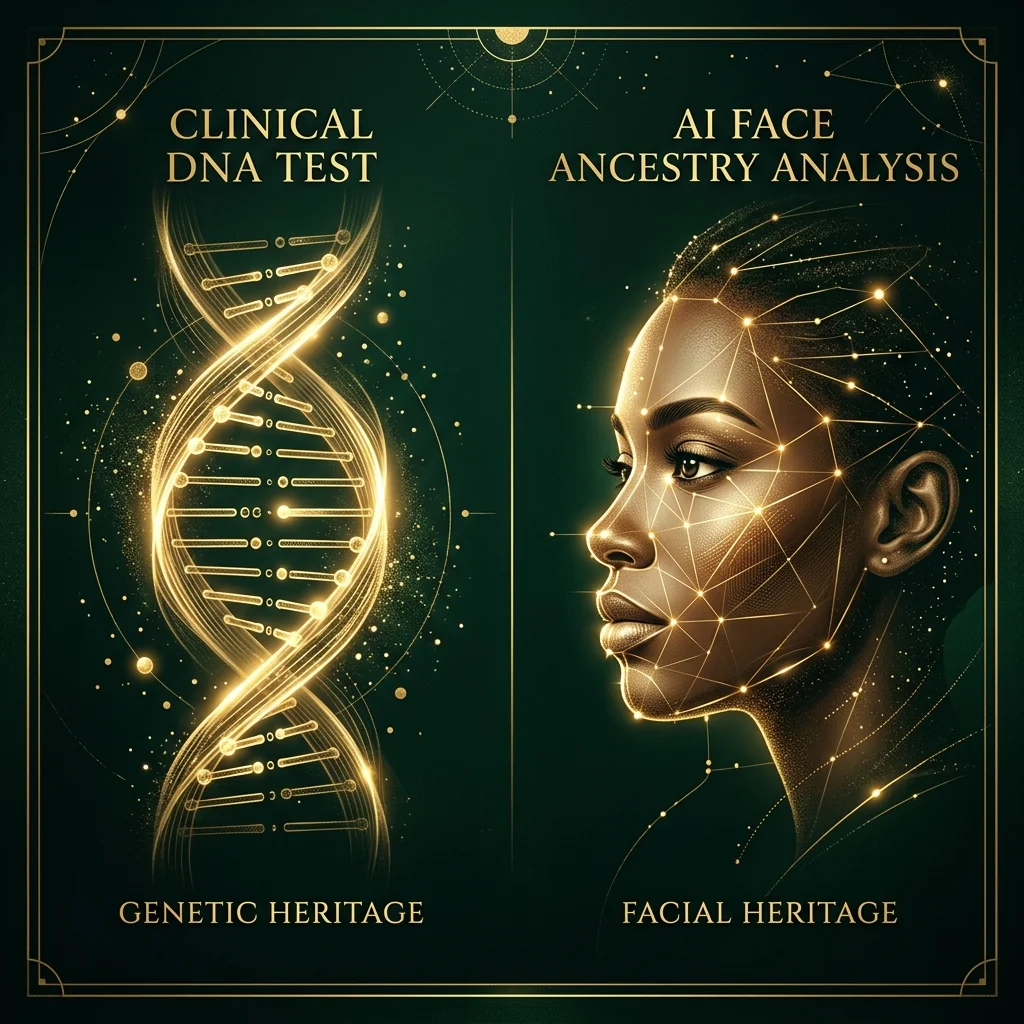
Can DNA predict what you look like?
DNA influences appearance, and researchers can estimate some visible traits from genetic variants. But entering ancestry percentages into an image generator does not reconstruct your actual face. A believable portrait is not evidence that the tool identified your features, ethnicity or nationality.
DNA face prediction, ancestry estimates and photo apps
| Tool | Typical input | How to read the output |
|---|---|---|
| Ancestry estimate | Genetic markers from a biological sample | A comparison with the provider's reference populations |
| DNA phenotyping model | Specific genetic variants and a trained statistical model | Predictions with uncertainty, within the conditions studied |
| AI portrait from an ancestry chart | A prompt or list of percentages | An imagined illustration, not your recovered appearance |
| Visual heritage app | A photograph | A visual interpretation that cannot verify DNA ancestry |
Before comparing two results, ask what each tool actually received. A program given “40% Region A, 60% Region B” has not been given your genetic variants. A program given your selfie already has an image of your appearance. Neither process is equivalent to reconstructing a face from laboratory DNA data.
Why an ethnicity percentage is not a facial blueprint
An ancestry summary compresses genetic comparisons into a few labels and numbers. It does not list the variants affecting each visible feature. Even eye color involves multiple genes, rather than the simple one-gene rule many people learned at school. MedlinePlus explains the complexity of eye-color inheritance.
Consider a hypothetical prompt that contains only two region names and percentages. It leaves age, expression, hairstyle, lighting and countless individual details unspecified. The generator must fill those gaps. Changing the wording can change the portrait without adding any genetic evidence. This is why asking whether an AI portrait “looks right” is a subjective comparison, not a validation study.
If your question is why your real appearance seems different from your report, read why people do not necessarily look like their DNA results. That is a separate question from whether software can reconstruct a face.
What does research on DNA-to-face prediction show?
Facial genetics is an active research field. NIH's overview of facial development describes many DNA regions associated with facial features. Association means researchers found a statistical relationship; it does not mean each feature can be recovered precisely for every individual.
A 2025 study in Nature Communications reported improved prediction of facial traits using genetic data from European study populations. Its inputs and measured outcomes are not interchangeable with a consumer ethnicity chart. Results from a defined study population should not be assumed to apply equally to every person or every commercial app.
The useful question is therefore not simply “Can AI make a face?” It is “Was this method tested on people outside its training data, and what exactly did it predict?” A realistic image can still be the wrong image of a person.
Before using a DNA face generator: five checks
- Identify the input. Does it use a photo, typed ancestry percentages or genetic variants? If it only uses your chart, describe its output as an ancestry-inspired portrait.
- Look for a defined claim. Predicting an eye-color category differs from matching an individual face. “AI accuracy” without a named outcome is not enough.
- Read the validation. Look for a study, an independent test set, the populations evaluated and a clear explanation of error. A gallery of attractive examples does not answer those questions.
- Check the data policy. Review retention, sharing and deletion before uploading a genetic file or photograph. You can explore the subject without uploading either.
- Label anything you share. Use wording such as “AI illustration inspired by my report.” Do not present the image as a recovered ancestor, a DNA-confirmed face or proof of identity.
Where Ancestor Lens fits
Ancestor Lens offers photo-based visual heritage exploration and historical look-alikes. It is not a DNA phenotyping service. A visual report cannot establish genetic ancestry, prove nationality or verify a family relationship. See how to use and interpret the app's photo results before treating a resemblance score as a fact about your family.
Frequently asked questions
Can ChatGPT generate my face from my DNA results?
An image generator can create a portrait inspired by the information you provide. An ancestry percentage list does not contain enough individual information to reconstruct your face. Treat the output as creative imagery.
Can a selfie reveal my DNA?
No. A selfie is an image, not a genetic sample. Looking at a face or generating a visual heritage label does not read a person's DNA sequence.
Does a convincing AI portrait prove the prediction worked?
No. A resemblance noticed after seeing a picture is not the same as a predefined test on independent data. Ask for measured validation before accepting an accuracy claim.
Can an ancestry estimate tell me my nationality?
A genetic comparison cannot establish citizenship or national identity. Our ethnicity, nationality and ancestry guide separates those terms.