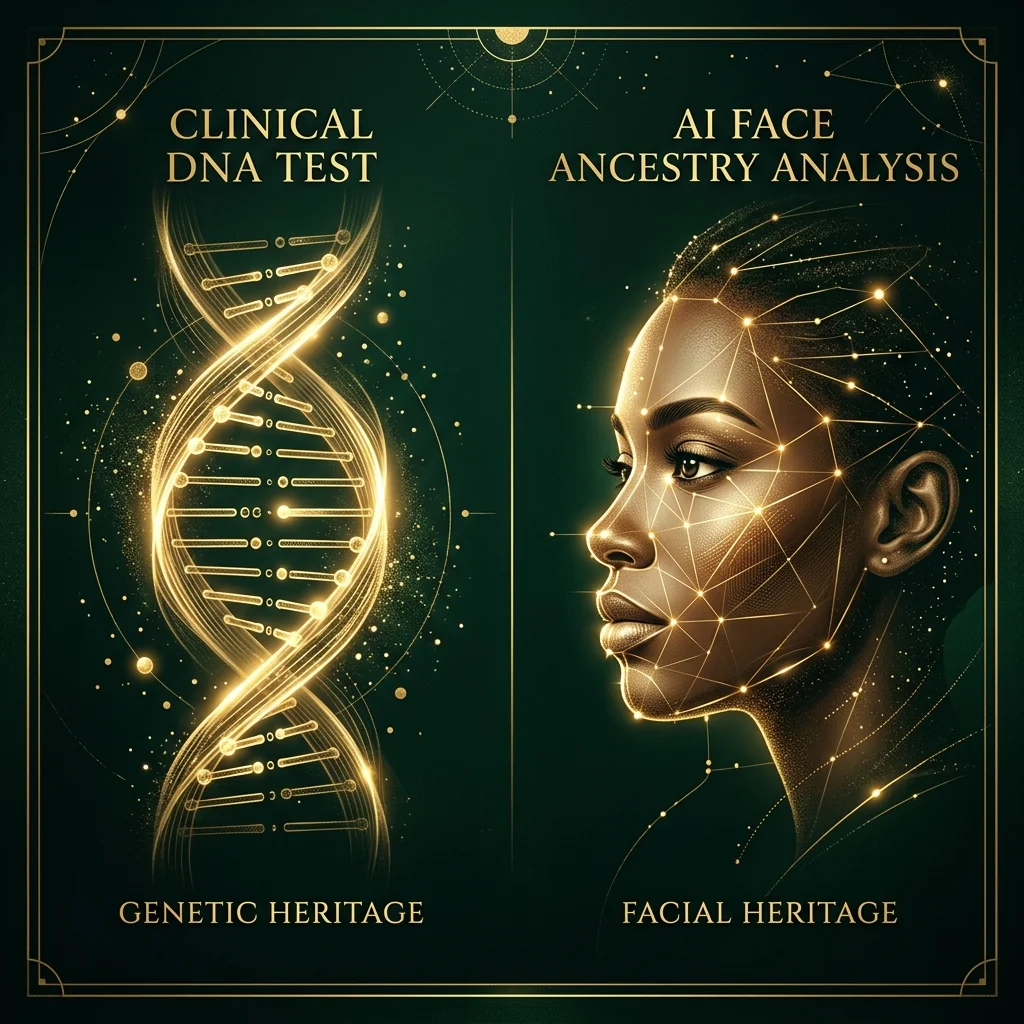
Related guide: Can DNA predict your face? Compare genetic research with AI-generated portraits.
You open your DNA results and see something like:
26% Irish
17% Greek & Balkan
9% Germanic Europe
7% other regions
Then you look in the mirror.
And you wonder: Do I actually look like my DNA results?
Maybe everyone has always guessed that you are Greek even though your largest DNA estimate is Italian. Maybe your results show significant Irish ancestry, but nobody has ever guessed Ireland. Or perhaps a relatively small ancestry region seems far more visible in your appearance than the largest percentage in your report.
That is not necessarily contradictory. DNA ancestry estimates and visible appearance reflect inheritance in different ways.
Compare Your Face With Your Roots
Discover which regional appearance patterns stand out in your selfie with Ancestor Lens.


Does Your Face Have to Match Your Biggest DNA Percentage?
No. Suppose your DNA estimate shows 50% Region A, 30% Region B, and 20% Region C. That does not mean your face should look “50% Region A.”
Ancestry percentages describe genetic similarities with selected reference populations. Your visible appearance comes from a complex combination of inherited traits. A distinctive feature inherited through a smaller family branch can sometimes strongly influence how people perceive your face.
Why Can a Smaller Ancestry Percentage Look More Visible?
Imagine that one grandparent contributes several noticeable features: distinctive eye shape, prominent cheekbones, dark curly hair, a recognizable nose, strong eyebrows, or a particular jawline. Even if another branch represents a larger share of your genetic ancestry, these highly visible traits may dominate how other people perceive you.
This is why someone might say: “You look exactly like your Greek grandmother.” even when Greece is not the largest region in the DNA estimate. Appearance is not a pie chart.
DNA Ancestry and Appearance Measure Different Things
A DNA ancestry service analyzes genetic information. A visual ancestry experience analyzes patterns visible in a photograph.
- DNA ancestry asks: Which reference populations does my DNA statistically resemble?
- Visual ancestry asks: Which regional appearance patterns does my face visually resemble?
These ideas are related, but they are not interchangeable. Read our breakdown on AI ancestry test vs DNA test for a full comparison.
Why Doesn't Everyone From the Same Country Look the Same?
There is no single Italian face, Greek face, Irish face, Polish face or German face. Every population contains enormous visual diversity. Populations also mixed across history through migration, trade, marriage, changing borders, and empires.
Why Do People Guess My Ethnicity Wrong?
People make visual guesses based on familiar patterns and stereotypes. They may notice hair, pigmentation, eyes, eyebrows, nose shape, or face shape and associate those cues with a country they know. That does not make the guess genetically accurate.
Why Do My Siblings Look More Like Our DNA Results Than I Do?
Siblings inherit different combinations of traits. One sibling may visually resemble a branch associated with the largest ancestry percentage, while another may strongly resemble a grandparent from another family branch. Read our guide on why siblings look different with the same parents.
Can a Small DNA Percentage Affect How I Look?
Possibly, but you cannot reliably assign one feature to one ancestry percentage. Similar facial traits exist across many populations, and facial appearance is influenced by many genetic factors.
Why Did My DNA Show a Country Nobody in My Family Mentioned?
Possible explanations include older ancestry, migration, neighboring populations, changing borders, forgotten family history, or statistical uncertainty.
Why Do Different DNA Companies Give Different Results?
DNA services use different reference populations, algorithms, and category definitions. Learn more in our article Why Do Ancestry DNA Results Differ Between Companies?.
Can AI Tell Whether My Face Matches My DNA?
AI can provide a visual comparison, but it cannot scientifically confirm a DNA ancestry result from a photograph. Ancestor Lens examines visible facial patterns and creates regional resemblance results. Read How Accurate Are AI Ethnicity Tests? to understand the technology behind visual analysis.
Try the DNA vs Face Challenge
1. Take a clear selfie.
2. Run your Ancestor Lens result.
3. Compare it with your DNA percentages!
Frequently Asked Questions
Do I have to look like my DNA results?
No. DNA ancestry percentages do not translate directly into facial percentages.
Why don't I look like my biggest ethnicity percentage?
A smaller family branch may contribute highly noticeable visible features.
Can people accurately guess ethnicity from appearance?
Not reliably. Similar visible traits appear across many populations.
Can siblings look like different ancestries?
Siblings can inherit different visible combinations of traits, so people may perceive their ancestry differently.
Can AI verify my DNA ancestry?
No. Photo-based AI cannot verify genetic ancestry.