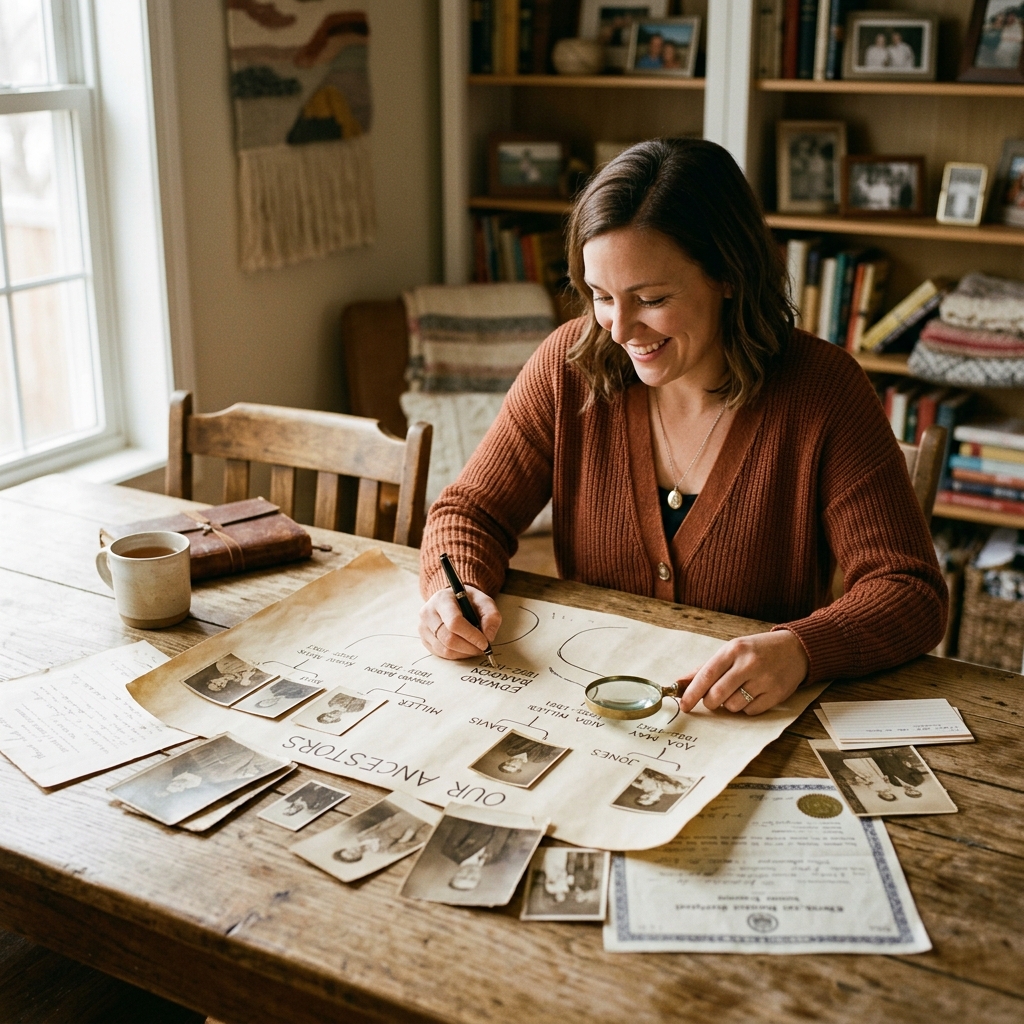
Have you ever wondered, “Where does my last name come from?”
A surname can be one of the easiest clues to your family history.
It may point toward a place, an occupation, an ancestor's first name, a physical characteristic, or a community your family belonged to hundreds of years ago.
But a last name alone cannot tell you your complete ancestry.
To discover where your surname really comes from, you need to combine its meaning with historical records, geography, family documents, and sometimes DNA evidence.
Here is how to investigate your surname step by step.
What Can Your Last Name Tell You About Your Ancestry?
Surnames developed for different reasons depending on country, language, culture, and historical period.
Many belong to a few broad categories.
1. Patronymic surnames
These surnames developed from the first name of a father or another ancestor.
Examples include names that originally meant:
- son of John;
- son of Peter;
- descendant of Donald;
- child of Ivan;
- descendant of a particular clan founder.
Common surname endings such as -son, -sen, -ov, -ev, -ić, -ez, -es or Mac- can sometimes provide linguistic clues.
However, similar endings can occur in several countries, so they should be treated as clues rather than proof.
2. Occupational surnames
Some surnames originated from jobs.
A person's ancestor may have been a:
- smith;
- baker;
- miller;
- carpenter;
- tailor;
- shepherd;
- fisherman;
- merchant.
As surnames became hereditary, the occupation remained as the family name even when later generations changed professions.
3. Geographic surnames
Many surnames describe where a family lived.
They may refer to:
- a village;
- a river;
- a mountain;
- a forest;
- a farm;
- a region;
- a neighboring country.
An ancestor who moved to another town might even have been identified by the place they came from.
That description could eventually become a permanent surname.
4. Descriptive surnames
Some surnames began as nicknames describing appearance, personality, age, height, hair color, or another characteristic.
Centuries later, the original meaning may have little connection with the people who carry the name today.
5. Clan, tribal, religious, or community names
In some societies, surnames developed through extended family groups, clans, religious communities, caste systems, or tribal structures.
This makes surname research highly dependent on historical and cultural context.
How to Find the Origin of Your Last Name
Instead of relying on one online surname dictionary, use several kinds of evidence.
Step 1: Write down the oldest version of your surname
Start with your own family.
Ask parents, grandparents, aunts, uncles, and older relatives:
- How was the surname spelled originally?
- Was the spelling changed after immigration?
- Did grandparents use another alphabet?
- Was there a shortened or translated version?
- What country or town did the family associate with the name?
The oldest known spelling is often much more useful than the modern version.
Step 2: Look for spelling variations
Surname spelling was historically much less consistent than it is today.
A single family name may appear differently in:
- birth records;
- marriage records;
- passenger lists;
- church registers;
- census records;
- military documents;
- naturalization files.
Clerks sometimes wrote names phonetically.
Immigrants also adapted surnames to new languages and alphabets.
When researching your surname, create a list of every known spelling.
For example, a surname ending in -ski might appear with -sky, while names transliterated from Cyrillic may have several English spellings.
Step 3: Find where the surname was historically concentrated
Geography is one of the strongest clues.
Search historical records and surname distribution databases to see where people with the name lived several generations ago.
Ask:
- Was the surname concentrated in one province?
- Does it appear mainly in one country?
- Is there a village with the same or similar name?
- Does the surname appear on both sides of a modern border?
Remember that current national borders may be very different from the borders that existed when your ancestors lived there.
A family could have lived in several different countries without ever moving because the border itself changed.
Step 4: Research the language of the name
Examine the linguistic structure of the surname.
Look at:
- prefixes;
- suffixes;
- root words;
- historical spellings;
- local language forms.
For example, a surname may contain an old word for a profession, place, family relationship, or geographic feature.
But avoid assuming nationality from the spelling alone.
Languages and surnames spread through migration, intermarriage, conquest, trade, and border changes.
Step 5: Build a small family tree
The most reliable way to determine where your surname comes from is to trace the actual people who carried it.
Begin with:
- yourself;
- your parents;
- your grandparents;
- your great-grandparents.
Record for each person:
- full name;
- birth date;
- birthplace;
- marriage;
- residence;
- death;
- parents.
Then work backward one verified generation at a time.
Our guide on how to build a family tree from scratch can help you organize this research.
Step 6: Search birth, marriage, and death records
Vital records can connect your surname with specific locations.
A marriage record may reveal where a person's parents lived.
A death certificate may list the birthplace of the deceased or their parents.
A baptismal record may identify a village that disappears from later documents.
Once you identify a consistent place, research the history of the surname there.
Step 7: Check immigration records
If your family migrated, passenger lists and naturalization documents can be especially valuable.
They may reveal:
- the original surname spelling;
- birthplace;
- nationality at the time;
- previous residence;
- nearest relative;
- destination;
- traveling family members.
This is often the point where an apparently American, British, Canadian, Australian, or other modern surname can be connected with an earlier European, Asian, African, Latin American, or Middle Eastern form. Read our dedicated guide on how to find your ancestors' immigration records to learn more about tracking passenger manifests and ship lists.
Can a Last Name Tell You Your Ethnicity?
Not reliably.
A surname can provide historical clues, but it cannot prove ethnicity.
The same surname may be carried by people with very different genetic and cultural backgrounds.
Families move.
Languages change.
People marry across communities.
Names are translated, shortened, adopted, or changed.
So a surname should be treated as one piece of ancestry evidence, not as a biological identity test.
Can You Determine Nationality From a Surname?
Sometimes you can identify a likely linguistic or geographic origin.
For example, a name may be strongly associated with Poland, Ireland, Italy, Greece, Spain, Scandinavia, the Balkans, or another region.
But nationality is more complicated.
Modern countries did not always exist in their current form.
An ancestor born in the same village could appear under different national labels on different historical records.
That is why place names and historical borders are often more useful than modern nationality labels.
What If My Last Name Is Very Common?
Common surnames require more evidence.
Instead of researching everyone with the surname, focus on your confirmed family line.
Use:
- first names;
- spouses;
- birth dates;
- occupations;
- addresses;
- villages;
- children's names;
- church affiliations.
These details help separate your ancestor from unrelated people with the same surname.
What If My Last Name Is Very Rare?
A rare surname can sometimes make genealogy easier.
Search for:
- early clusters of the surname;
- variations in neighboring villages;
- historical maps;
- cemetery records;
- church books;
- immigration documents.
If most early records occur in one small area, that region may be an important part of your family story.
However, rarity does not necessarily mean everyone with the surname shares a recent common ancestor.
Did Immigration Officials Change People's Last Names?
Surname changes often happened during the broader immigration and assimilation process rather than through one universal rule.
Families sometimes:
- simplified difficult spellings;
- translated names;
- removed accents;
- adopted phonetic versions;
- shortened long surnames;
- changed names to fit the language of a new country.
This means you should search both the modern surname and possible older versions.
Can DNA Help Identify a Surname Origin?
Sometimes.
DNA matches can help connect you with relatives who descend from the same family line.
If several verified DNA relatives trace their ancestry to the same place or surname branch, that can support documentary research.
However, DNA ethnicity percentages alone generally cannot prove the origin of a specific surname. For a full breakdown of how ethnicity estimates work, check out our guide on what ancestry DNA percentages really mean.
For that, family-tree records and DNA matches are usually more useful.
Read our guide to understanding DNA matches if you want to use genetic relatives in your family research.
Can AI Tell Where My Surname Comes From?
AI tools can help explain linguistic patterns or organize historical information, but they can also produce incorrect surname meanings.
Always verify claims against:
- historical dictionaries;
- archives;
- genealogy databases;
- original records;
- reputable academic or linguistic sources.
A plausible explanation is not necessarily the correct explanation for your particular family.
Surname Origin vs Family Origin
This distinction is important.
The surname origin tells you where or how a name may have developed.
Your family origin tells you where your actual ancestors lived.
Those two stories can be different.
For example, a surname may have originated in one region centuries ago while your documented family lived somewhere else for many generations.
That is why the best ancestry research combines surname history with a verified family tree.
A Simple Surname Research Checklist
When researching your last name, collect:
- current spelling;
- historical spellings;
- oldest known ancestor carrying the name;
- birthplace;
- religion if relevant to local records;
- language;
- migration history;
- nearby towns and villages;
- immigration documents;
- birth and marriage records;
- DNA matches if available.
Then look for patterns. The strongest answer usually comes from several clues pointing toward the same region.
Frequently Asked Questions
Where does my last name come from?
Start by finding the oldest documented spelling in your family and the earliest confirmed place where your ancestors lived. Then research the surname's linguistic meaning and geographic distribution.
Can my surname tell me what country my ancestors came from?
It can provide a clue, but it cannot prove ancestry by itself. Historical records are needed to connect your specific family with a country or region.
Why does my surname have several spellings?
Names were often written phonetically, transliterated between alphabets, or adapted after migration. Historical spelling was also less standardized than modern spelling.
Can two unrelated families have the same last name?
Yes. Many surnames developed independently in different places, especially common occupational, geographic, and patronymic names.
Can a last name prove ethnicity?
No. A surname can reveal linguistic, geographic, or historical clues, but it cannot establish a person's ethnicity or genetic ancestry.
How far back can I trace a surname?
It depends on the location and surviving records. Some family lines can be documented for several centuries, while others become difficult to trace after only a few generations.
Final Thoughts
Your last name can be a fascinating doorway into your ancestry, but the name itself is only the beginning.
Start with the oldest people in your family, locate the earliest documented spelling, trace where your ancestors lived, and compare the surname with historical records.
The goal is not simply to discover what a surname dictionary says.
It is to answer a more interesting question:
Where did the people in my family who carried this name actually come from?
Continue Your Ancestry Research
Explore these guides next:
- 👉 How to Build a Family Tree From Scratch
- 👉 How to Research Your Family History Without a DNA Test
- 👉 How to Find Your Ancestors' Immigration Records
- 👉 How to Understand DNA Matches
- 👉 What Do Ancestry DNA Percentages Really Mean?
Begin My Ancestry Journey
Start exploring your visual heritage with Ancestor Lens. Upload a photo and discover which countries your face visually resembles — no DNA required.

