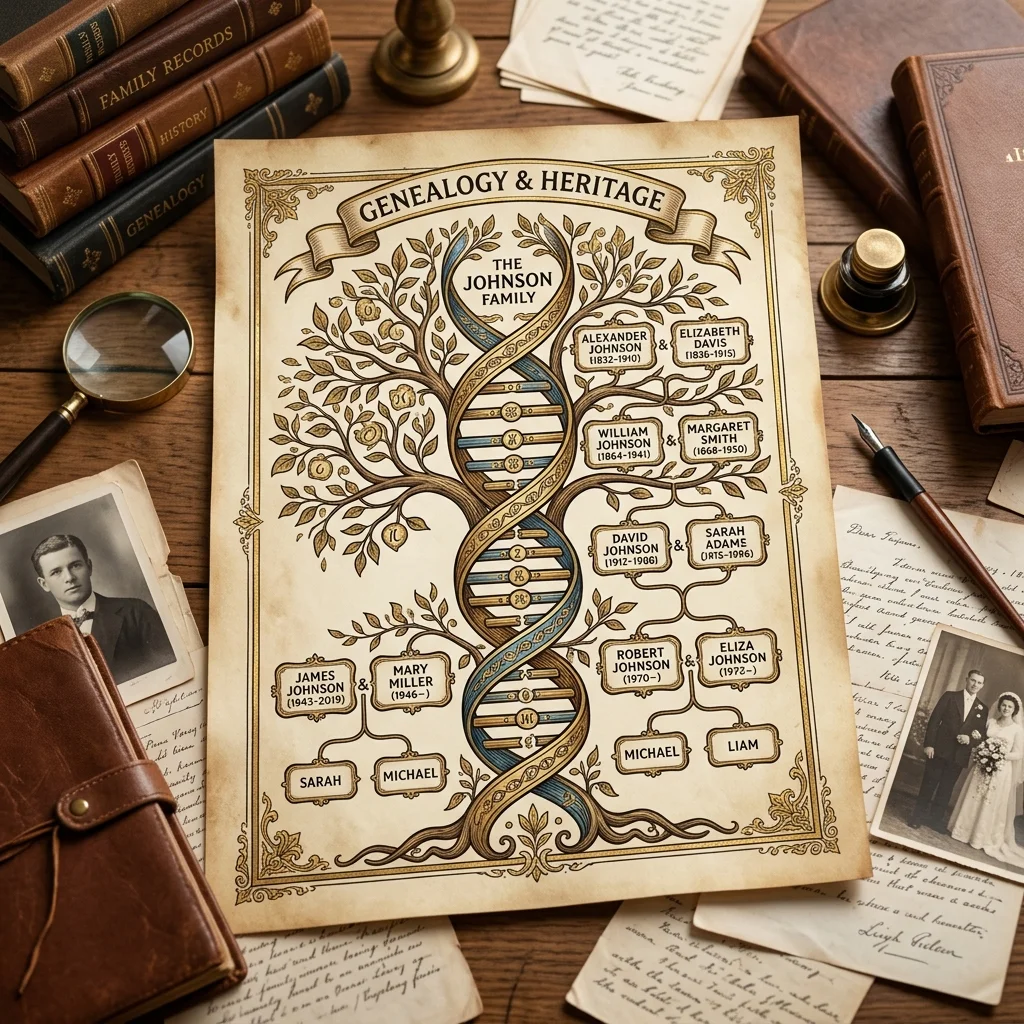
You take an ancestry DNA test and receive information about your origins.
But how far into the past can that DNA actually see?
Five generations?
Ten generations?
Hundreds of years?
Thousands?
The answer depends on what part of the DNA result you are using.
An ancestry test can provide ethnicity estimates, identify genetic relatives and support family-tree research, but those three features do not have exactly the same historical reach.
How Many Generations Does Ancestry DNA Go Back?
For genealogical research, autosomal DNA is generally most useful for relatively recent generations.
As you move further back in your family tree, the amount of DNA inherited from any individual ancestor becomes smaller and increasingly unpredictable.
You inherit approximately:
- 50% from each parent;
- around 25% from each grandparent on average;
- around 12.5% from each great-grandparent on average;
- around 6.25% from each great-great-grandparent on average.
Continue going back and the expected contribution becomes smaller.
But real inheritance is not divided into perfectly equal slices.
DNA recombination is random.
That means you may inherit detectable DNA from one distant ancestor but little or no detectable autosomal DNA from another ancestor who lived during the same generation.
Your Genealogical Family Tree Is Bigger Than Your Genetic Family Tree
This distinction is extremely important.
Your genealogical family tree includes all of your documented ancestors.
Your genetic family tree includes ancestors from whom you inherited DNA that is still detectable in your genome.
The further back you go, the greater the possibility that a real genealogical ancestor contributed little or no autosomal DNA that can still be identified in you today.
That ancestor is still your ancestor.
They simply may not be visible through your personal autosomal DNA test.
How Many Ancestors Do You Have Each Generation Back?
In a simplified family tree:
- Parents: 2
- Grandparents: 4
- Great-grandparents: 8
- 2× great-grandparents: 16
- 3× great-grandparents: 32
- 4× great-grandparents: 64
- 5× great-grandparents: 128
- 6× great-grandparents: 256
The theoretical number grows rapidly.
Real family trees are more complicated because the same ancestors may appear on multiple branches — a phenomenon known as pedigree collapse.
But the basic point remains:
The further back you travel, the more genealogical ancestors you have competing for representation within the same finite genome.
Can DNA Identify One Exact Ancestor Hundreds of Years Ago?
Usually not from an ethnicity percentage alone.
Suppose a DNA test reports:
4% Scandinavian.
It is tempting to say:
“That must come from one Scandinavian ancestor six generations ago.”
But ancestry estimates do not work that precisely. Read our detailed guide on what ancestry percentages really mean.
That percentage could reflect:
- several ancestors;
- overlapping populations;
- reference-population similarities;
- historical migration;
- statistical uncertainty;
- DNA inherited through several family branches.
A regional percentage cannot normally tell you exactly which named ancestor contributed it.
To identify a specific ancestor, genealogy records and DNA matches are much more useful.
How Far Back Can DNA Matches Go?
DNA matching compares your genetic data with other people in a testing database.
Close relatives typically share larger DNA segments.
As relationships become more distant, shared segments become smaller and less predictable. Read our guide on how to understand DNA matches for actionable advice.
This means DNA matching is strongest for recent relatives and gradually becomes less reliable for identifying increasingly distant relationships.
A distant cousin may descend from the same historical ancestor as you while sharing very little detectable autosomal DNA.
Another cousin at the same genealogical distance may happen to share enough DNA to be detected.
This is why DNA matches should be combined with documented family-tree research rather than treated as a complete map of every biological relative.
Why Testing Older Generations Helps
If you want to push ancestry research further into the past, testing older living relatives can be extremely valuable.
For example:
Your grandparent carries DNA directly inherited from generations that are further removed from you.
Your parent has inherited more DNA from your grandparents than you have.
Therefore, DNA from:
- grandparents;
- parents;
- great-aunts;
- great-uncles;
can preserve genetic information that you did not inherit yourself.
An older relative may also have DNA matches that do not appear in your own account.
What About Ethnicity Estimates?
Ethnicity estimates work differently from cousin matching.
Testing companies compare segments of your DNA with present-day reference populations and use statistical models to estimate regional ancestry.
These estimates can sometimes reflect population history from many hundreds of years ago.
But they do not provide a literal list of your ancestors from that period.
An ethnicity result saying that your DNA resembles populations associated with Ireland, Southern Italy, Eastern Europe or the Balkans does not mean the test has identified a particular Irish, Italian, Polish or Greek ancestor from a specific century.
Think of ethnicity estimates as regional genetic signals, not a complete historical family tree.
Can DNA Trace Ancestry Thousands of Years Back?
Some specialized genetic analysis can explore very ancient population history.
But this is different from normal genealogical identification.
A consumer ancestry result may describe broad population relationships connected to migrations that occurred many centuries or millennia ago.
That does not mean it can identify your individual ancestors from those periods.
There is a large difference between:
“Your DNA contains patterns associated with an ancient population.”
and:
“We know exactly who your ancestor was in the year 900.”
The first can be explored statistically.
The second usually requires historical records that often do not exist.
Autosomal DNA vs Y-DNA vs Mitochondrial DNA
Different forms of genetic testing answer different questions.
Autosomal DNA
Autosomal DNA is inherited from both sides of the family. It is commonly used for ethnicity estimates, cousin matching, recent genealogy, and identifying unknown relatives. Its genealogical usefulness becomes less predictable with distant generations.
Y-DNA
Y-DNA follows the direct paternal line. It can be useful for investigating deep paternal-line connections. Because only males carry a Y chromosome, it represents just one narrow branch of a much larger family tree.
Mitochondrial DNA
Mitochondrial DNA is inherited through the direct maternal line. Both men and women inherit mitochondrial DNA, but only women pass it to the next generation. Like Y-DNA, it can reach much further into deep ancestry while representing only one direct ancestral line.
How Far Back Can Family Records Go?
Sometimes records can take you further than autosomal DNA.
If you want to start building documentation, read how to build your family tree from scratch or explore how to trace your ancestry without DNA.
Useful sources include:
- birth certificates;
- marriage records;
- death certificates;
- church registers;
- census records;
- immigration records;
- military records;
- land records;
- newspapers;
- wills;
- historical directories;
- cemetery records.
The availability of these records varies enormously by country, region, religion and historical period.
In some families, reliable documentation may stop after only a few generations.
Others may trace individual branches back several centuries.
DNA and Family Trees Work Best Together
DNA is most powerful when it supports documentary research.
Imagine your family tree suggests that your great-great-grandmother came from Southern Italy.
Your DNA estimate contains Southern European ancestry.
Several DNA matches also descend from families in the same Italian province.
Each clue alone is incomplete.
Together, they form much stronger evidence.
The best ancestry research usually combines:
- DNA results;
- DNA matches;
- family interviews;
- historical records;
- surnames;
- locations;
- migration patterns;
- old photographs.
Can Your Face Reveal Older Family Connections?
Sometimes people first become curious about ancestry because of appearance.
You may strongly resemble:
- a grandparent;
- a great-grandparent in an old photograph;
- one side of your family;
- facial patterns people associate with a particular region.
Appearance is not a genetic ancestry test and cannot identify historical ancestors. But you can learn more about how to compare your face with your DNA results.
Visual curiosity can be an interesting starting point.
Ancestor Lens lets you explore which regional appearance patterns your face visually resembles.
Explore Your Visual Heritage
Upload a clear photo and explore the regional appearance patterns associated with your face. No saliva sample. No laboratory wait. Just a visual ancestry experience designed for curiosity and discovery.


How to Trace Your Ancestry as Far Back as Possible
If your goal is to explore the deepest reliable family history possible, use several approaches together.
1. Start with yourself
Record full names, dates, places, and family relationships.
2. Interview older relatives
Ask about grandparents, villages and towns, maiden names, migrations, family stories, languages, and religious communities.
3. Build a documented family tree
Do not copy unsourced online trees automatically. Verify each generation before moving further back.
4. Use DNA matches
Focus on matches that can be connected to known family branches.
5. Test older relatives when possible
They can preserve genetic information from earlier generations that you may not have inherited.
6. Compare geography with DNA results
Look for overlap between documented places and regional ancestry signals.
7. Preserve old family photographs
Photographs can reveal family resemblance and add a human dimension to genealogical records.
Frequently Asked Questions
How many generations can an ancestry DNA test detect?
There is no single fixed number. Autosomal DNA is most useful for relatively recent genealogy and becomes less predictable as generations become more distant.
Can ancestry DNA go back 1,000 years?
DNA can reflect population history from very old periods, but an ordinary ethnicity estimate cannot identify each individual ancestor who lived 1,000 years ago.
How far back does 1% DNA ancestry go?
You cannot reliably convert a 1% ethnicity estimate into one exact ancestor or generation. Genetic inheritance and ethnicity estimation are more complicated than simple percentage division.
Can DNA identify all of my ancestors?
No. The further back your family tree goes, the more likely it becomes that some real genealogical ancestors contributed no autosomal DNA that remains detectable in you.
Is DNA better than a family tree?
They answer different questions. DNA can reveal genetic relationships and ancestry signals, while historical documents can identify particular people, dates and places. The strongest research combines both.
Can a face ancestry app trace generations?
No. Face analysis does not trace genealogical generations or replace DNA testing. It explores visual resemblance and appearance patterns.
Final Thoughts
So, how far back does ancestry DNA go?
There is no single number.
DNA can help reveal:
- relatively recent genetic relatives;
- regional ancestry patterns;
- deeper population history;
- connections that support family-tree research.
But the further back you go, the harder it becomes to connect your DNA with one specific individual ancestor.
Your DNA is therefore best viewed as one layer of evidence.
Combine it with records, relatives, photographs and family history, and you can build a far richer picture of where you came from.
Begin My Ancestry Journey
Start exploring your visual heritage with Ancestor Lens. Upload a photo and discover which countries your face visually resembles — no DNA required.