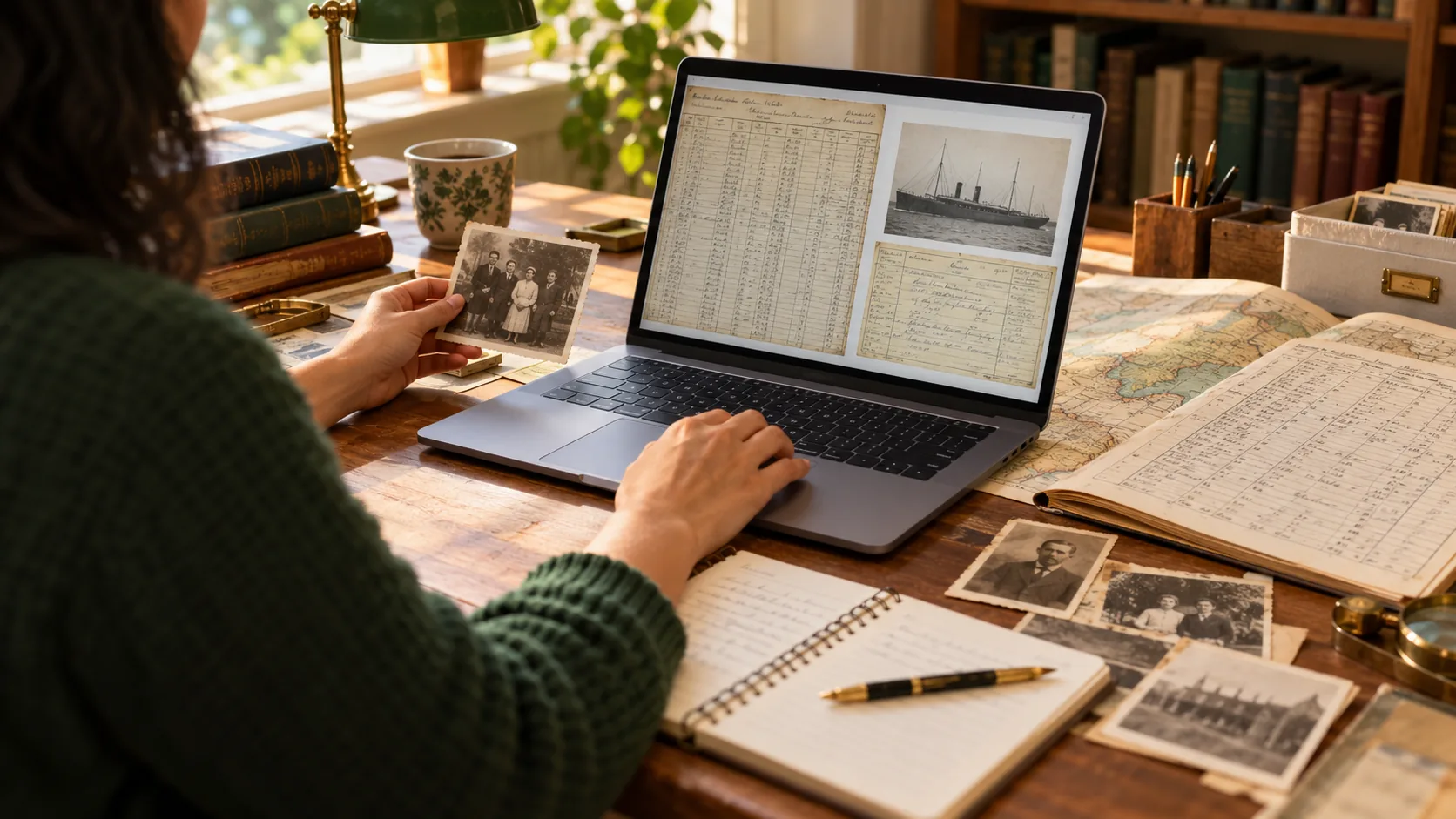
Quick answer
Start with yourself and work backward using certificates, family interviews and photographs. Then search free collections from FamilySearch, national and state archives, census projects, libraries, historical societies, cemetery databases and digitized newspapers. Confirm each relationship with more than one record whenever possible, save the source URL or citation, and keep uncertain people out of your main tree until the evidence agrees.
What to collect before searching online
The best free genealogy source is often already in the family. Begin with the most recent facts you can verify and ask relatives for names, nicknames, maiden names, approximate dates and places. Photograph certificates, funeral cards, letters, labeled albums, military papers and the backs of old photographs.
Create a simple research profile for one target person:
- full name and every known spelling;
- birth, marriage and death dates or ranges;
- town, county, province or country;
- names of spouse, parents, siblings and children;
- occupation, religion, military service and migration clues;
- the source for each fact and whether it is confirmed or only remembered.
If you do not yet have a structure, follow our guide to building a family tree from scratch. Work backward from a proven person instead of attaching a famous or similarly named family to the tree.
Best places to find genealogy records for free
No single website contains every record. Availability depends on country, time period, privacy law and whether a collection has been digitized. Use several types of repository and search the place where the event occurred.
| Free source | What you may find | Best use |
|---|---|---|
| FamilySearch | Indexed records, image collections, shared family tree, catalog, books and research guides | Broad international searching and location-specific guidance; a free account is required for many records. |
| National archives | Census, immigration, naturalization, military, land and government records | Finding original or official evidence and learning what survives for a jurisdiction. |
| State, provincial and regional archives | Vital records, court files, tax lists, maps and local collections | Research that is too local or too recent for a national archive. |
| Public and university libraries | Newspapers, city directories, local histories, yearbooks and database access | Finding addresses, occupations, obituaries and community context. |
| Historical and genealogical societies | Cemetery surveys, church registers, indexes and member research | Collections created locally that may not exist elsewhere online. |
| Cemetery and memorial databases | Grave photographs, dates, relatives and cemetery locations | Generating clues; verify user-contributed details with other records. |
| Digitized books and newspapers | Obituaries, legal notices, biographies, local histories and announcements | Connecting people between official record dates and revealing relationships. |
FamilySearch and its Research Wiki
FamilySearch provides free accounts and access to large collections of indexed records, digitized images and family-tree tools. Its Research Wiki is especially useful when you do not know which records exist for a country or locality. Search the place first, then the record type—such as civil registration, church records or census.
National archives and government databases
Government archives often explain record coverage even when every image is not online. In the United States, the National Archives highlights census, military, immigration, naturalization and land records as major genealogy sources. Other countries maintain their own national, regional and municipal archives; search for the official archive of the place where your ancestor lived.
Free access through a library or archive
A database that charges at home may be available without cost inside a public library, university, FamilySearch center or National Archives facility. Ask a librarian which family-history and newspaper databases your card includes. Remote access sometimes works with a library login, while other collections are available only on-site.
Free does not always mean fully online
A catalog entry may prove that a record exists without displaying its image. Use the collection description to learn who holds the original, then request a scan, visit a local archive, contact a volunteer or ask a library about interlibrary services.
A step-by-step plan to find an ancestor
- Choose one research question. “Who were Maria Rossi's parents?” is more useful than “Find everything about the Rossi family.”
- Build a timeline. List every confirmed event with date, place and source. Gaps show what to search next.
- Search the most recent record first. A death certificate or obituary may name parents, a spouse or a birthplace that leads backward.
- Search with ranges. Ages and spellings change. Try a birth range of several years and omit fields that may be wrong.
- Search relatives and neighbors. Siblings, witnesses, godparents and nearby households can reveal a maiden name or hometown.
- Open the image. An index may omit occupations, addresses, witnesses or marginal notes visible in the original document.
- Record negative searches. Note the database, date range and spellings checked so you do not repeat the same work.
- Confirm the link. Prefer two independent sources that connect one generation to the next.
Use name variations deliberately
Search surname variants, phonetic spellings, translated first names, initials and common transcription errors. A clerk may have written what they heard. An immigrant may have used one name in the country of origin and another after migration. Search by spouse, child, occupation or address when the name fails.
Search by place, not only by person
Genealogy records are created by jurisdictions and institutions. Learn the county boundaries, parish, registration district and archive responsible at the time of the event. Modern maps may not match historical borders. Place pages in archive catalogs and research wikis can reveal collections that a global name search misses.
How to find an ancestor who seems to disappear
When a person vanishes between two records, look for an event that changed how they were described: marriage, migration, military service, adoption, boundary change, spelling change or residence in another relative's household.
- Search a spouse's or child's name instead.
- Compare addresses in city directories year by year.
- Check siblings' obituaries for married names and locations.
- Search passenger lists, border crossings and naturalization files.
- Look for probate, land and court records that name heirs.
- Search newspapers with a town, occupation or street name.
For an immigrant ancestor, use the dedicated workflow in How to Find Your Ancestors' Immigration Records Online. If a surname is the only clue, start with how to research a last name's origin and spelling history.
Five mistakes that create the wrong family tree
- Copying another tree without sources. Use it as a clue, then verify each relationship yourself.
- Choosing the first matching name. Prove identity with place, age, relatives, occupation and timeline.
- Ignoring the original image. Transcriptions can be incomplete or incorrect.
- Forcing family stories to fit. Preserve the story, but label it as oral history until records support it.
- Skipping source citations. Save enough information to find the record again: repository, collection, person, date, image or page, and URL with access date.
A simple research log
For every search, record the date, website or archive, collection name, exact query, result and next step. This small habit saves time and makes it easier to explain why two records refer to the same person. It also separates proven facts from working theories.
Can you research ancestry without DNA?
Yes. Documentary genealogy existed long before consumer DNA testing. Records can identify parents, spouses, residences, occupations, migrations and community ties. DNA can help confirm or challenge a paper trail, especially when records are missing, but it is optional. Read how to trace ancestry without a DNA test for a records-first approach.
Frequently asked questions
Can I find my ancestors online for free?
Yes, many indexed records, catalogs and digitized images are free. Coverage varies by place and date. FamilySearch, government archives, libraries and historical societies are strong starting points.
What information do I need to search for an ancestor?
A name plus an approximate date and place is a useful minimum. Relatives, occupation, religion and migration details help distinguish people with the same name.
Is a free online family tree accurate?
A tree is only as reliable as its sources. Shared trees can contain valuable clues and serious errors. Check the original records attached to every parent-child connection before copying it.
Where should a beginner start genealogy research?
Start with yourself, then your parents and grandparents. Interview relatives, gather home records and work backward one generation at a time. Do not begin by searching for a surname alone across the entire world.
Do I need to pay for census or archive records?
Many are free through government sites or partner projects, while some digitized images sit behind commercial subscriptions. Libraries and archives may provide free on-site or remote access to subscription databases.
Sources and free research portals
- U.S. National Archives: Start Your Genealogy Research
- U.S. National Archives: Free online databases
- FamilySearch: Is FamilySearch free?
- FamilySearch: Using the Research Wiki
Record access and privacy restrictions differ by country and can change. Check each repository's current terms and collection description.

