“Your eyes are exactly like your mother’s.”
“No way — that is your father’s face.”
“You actually look more like your grandmother.”
Almost every family has this debate. And sometimes nobody agrees.
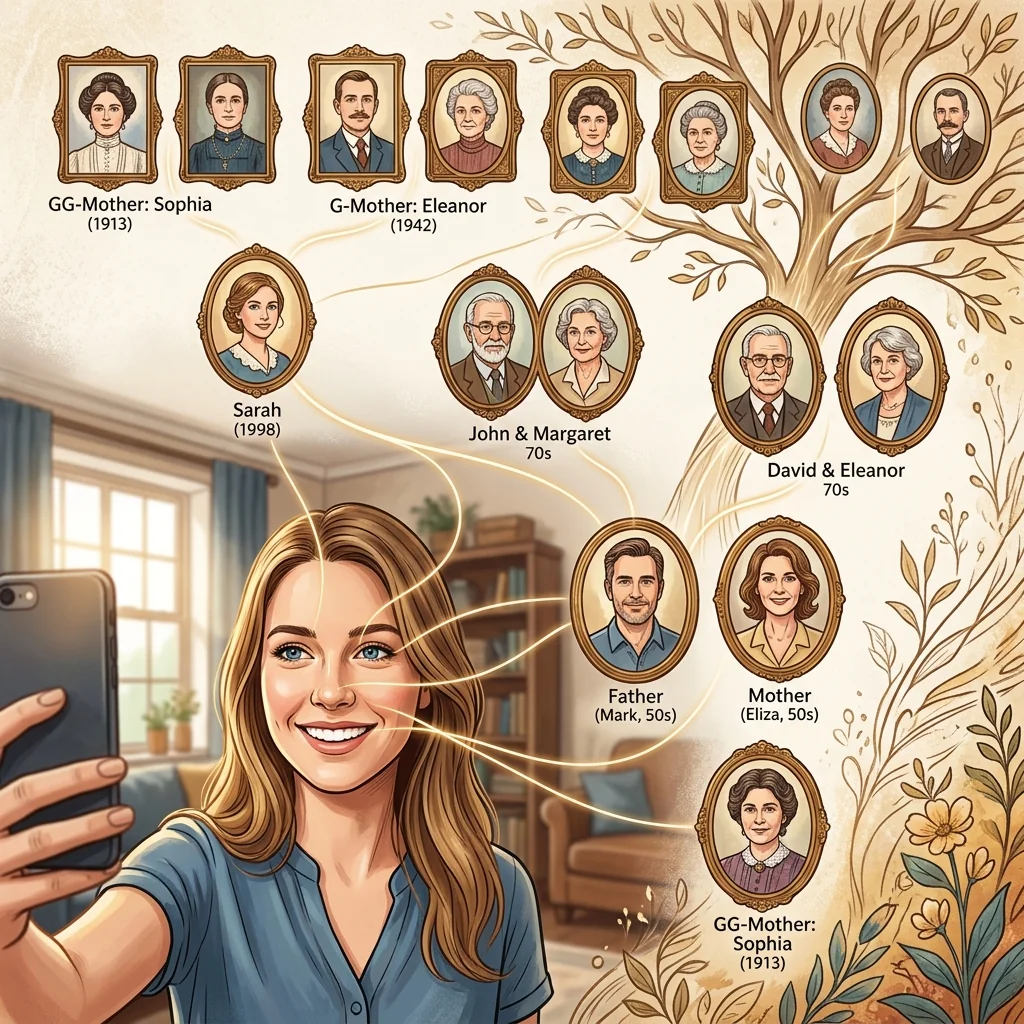
A face is not inherited as one complete package from either parent. Instead, many visible traits combine to create a unique appearance. You may have your mother’s eye shape, your father’s jawline, your grandfather’s nose, and an expression that reminds everyone of your grandmother.
That is what makes one simple question so fascinating:
Which parent do I look like more?
You can compare family photos manually — or use a visual ancestry experience such as Ancestor Lens to explore which family and regional appearance patterns stand out most strongly in your face.
Analyze Your Face Instantly
Discover which facial feature patterns stand out most strongly in your selfie.


Table of Contents
- Why Do Children Look Like Their Parents?
- Can You Really Look More Like One Parent?
- Which Facial Features Should You Compare?
- Why Do I Look Like My Dad More Than My Mom?
- Why Do I Look Like My Mom More Than My Dad?
- Can You Look Like Neither Parent?
- Why Do I Look More Like My Grandparent?
- Why Do Siblings Look So Different?
- Which Side of the Family Won My Face?
- Can AI Compare Family Resemblance?
- Try a Three-Generation Family Test
- Frequently Asked Questions
Why Do Children Look Like Their Parents?
Children inherit genetic material from both biological parents. But visible appearance does not work like a perfectly divided 50/50 photograph.
Your appearance is influenced by many inherited factors associated with:
- face shape;
- eye shape;
- eye color;
- eyebrow structure;
- nose shape;
- cheekbones;
- jawline;
- chin;
- hair texture;
- hair color;
- pigmentation;
- facial proportions.
Different features can resemble different relatives. That means you may strongly resemble one parent overall while still carrying clearly visible features associated with the other side of the family.
Can You Really Look More Like One Parent?
Yes. One child may appear much more similar to their mother while a sibling strongly resembles their father. This does not mean that one child simply inherited “more” from one parent. The visible combination is different.
For example:
Person A
- Mother’s eyes
- Mother’s face shape
- Father’s nose
- Mother’s eyebrows
- Grandfather’s chin
Overall impression: strongly resembles the mother.
Person B
- Father’s jaw
- Father’s eyes
- Mother’s mouth
- Father’s eyebrows
- Grandmother’s cheekbones
Overall impression: strongly resembles the father.
A few particularly noticeable facial features can strongly influence how people perceive the whole face.
Which Facial Features Should You Compare?
Instead of judging the entire face at once, compare specific areas.
Eyes
Look at shape, spacing, eyelid structure, angle, and eyebrow position.
Nose
Compare bridge, width, tip, nostrils, profile, and proportion.
Face Shape
Does the face look oval, round, square, long, heart-shaped, or angular?
Cheekbones
Compare their height, width and prominence.
Jaw and Chin
Look at jaw width, chin shape, projection and lower-face proportions.
Mouth and Smile
Sometimes family resemblance becomes much more obvious when someone smiles. Compare lip shape, smile width, dimples, asymmetry, and expression.
Hair
Compare texture, curl pattern, density, hairline, and natural color.
Why Do I Look Like My Dad More Than My Mom?
You may have inherited several highly visible features that resemble your father, such as his face shape, eye placement, eyebrows, jawline, or smile. Other features may still resemble your mother, but people may notice the paternal features first.
Why Do I Look Like My Mom More Than My Dad?
The same principle works in the opposite direction. If several dominant visual features resemble your mother, people may immediately associate your face with hers.
Photographs taken at similar ages are especially useful. Instead of comparing yourself at 25 with your mother at 55, try finding a photograph of her when she was approximately your current age. The resemblance may become much more obvious.
Can You Look Like Neither Parent?
Yes. Some people resemble neither parent strongly at first glance. They may instead resemble a grandmother, grandfather, aunt, uncle, great-grandparent, or several relatives combined. Your parents carry inherited traits from earlier generations, and some of those traits may become much more visually prominent in you.
Why Do I Look More Like My Grandparent?
Families often describe this as a feature that “skipped a generation.” You can read more about this in our article on why you may resemble a grandparent. Your parent may carry traits associated with their mother or father without expressing them as visibly. You may inherit a combination in which those traits become much more noticeable.
Why Do Siblings Look So Different?
Biological siblings usually inherit different combinations of genetic material. One sibling may resemble the maternal side, another the paternal side, and a third may look more like a grandparent. Discover more in our guide on why siblings look different with the same parents.
Which Side of the Family “Won” My Face?
Social media often frames the question as: Mom’s side vs. Dad’s side — who won?
Scientifically, neither side “wins.” But as a visual experiment, it is compelling. Try comparing your selfie with your mother, father, and grandparents at approximately the same age. If you have also taken a genetic test, explore which parent your ancestry came from to compare your DNA inheritance with your visual resemblance.
Can AI Compare Family Resemblance?
AI can analyze visible facial patterns and produce interesting visual comparisons. Ancestor Lens lets you explore features such as facial proportions, eye structure, nose shape, jawline, cheekbones, and face shape.
It can also show which regional or historical appearance patterns your face visually resembles. Read about what your face may say about ancestry to see how visual AI evaluates features.
Discover Your Family Resemblance
Compare your selfie with Ancestor Lens to explore visual ancestry profiles.
Try a Three-Generation Family Test
- Upload your own clear selfie (Check our guide on best photo for an AI ancestry test).
- Compare your result with your mother or father.
- If available, try a clear photograph of a grandparent.
- Compare which regional or visual patterns repeat.
Frequently Asked Questions
Which parent do I look like more?
Compare individual features such as eyes, nose, face shape, cheekbones, jaw, mouth and smile. Your overall appearance may resemble one parent more strongly even though visible features come from both sides.
Can AI tell whether I look more like my mom or dad?
AI can compare visual features, but it cannot prove genetic inheritance or biological relationships from a photograph alone.
Why do I look like my dad but my sibling looks like my mom?
Siblings usually inherit different combinations of traits, which can make one resemble the paternal side and another the maternal side.
Can I look more like my grandparent than my parents?
Yes. Traits inherited through your parents can create a strong visible resemblance to a grandmother or grandfather.
Does looking like my mother mean I inherited more DNA from her?
Not necessarily. Visual resemblance and total genetic inheritance are different concepts. Learn more about DNA results and appearance.
Can my face reveal which side my ethnicity comes from?
Appearance can inspire family-history questions, but it cannot reliably identify which family branch contributed a particular ethnicity.