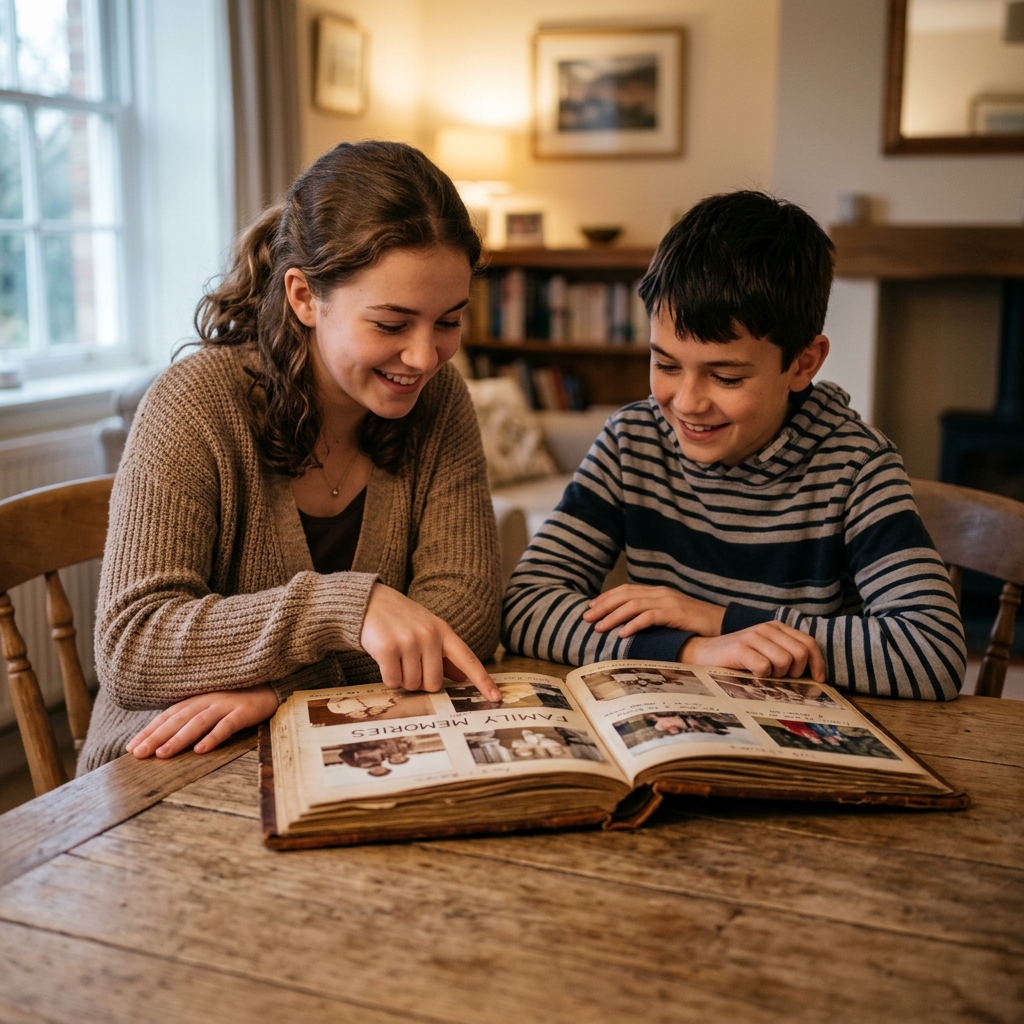
Two siblings can have the same parents and still look surprisingly different.
One may have their mother’s eyes and their father’s jawline. Another may resemble a grandparent so strongly that old family photographs feel almost uncanny. Even identical family backgrounds do not create identical faces.
So why do brothers and sisters sometimes look unrelated, and why might they receive different results from a visual ancestry app?
The answer lies in the complex way families pass down traits across generations.
Siblings Do Not Inherit the Exact Same Combination of Traits
Each child receives a unique combination of genetic material from their parents.
Full biological siblings share much of their family ancestry, but they do not usually inherit the exact same set of variants. This means one sibling may express certain visible traits more strongly while another expresses a different combination.
These differences may affect:
- Eye color and eye shape
- Hair color and texture
- Nose shape
- Face shape
- Jawline
- Cheekbones
- Lips
- Skin pigmentation
- Height and body structure
A family can contain a wide range of appearances even when everyone shares the same general ancestry.
Why One Sibling May Look Like the Mother and Another Like the Father
People often describe a child as “the image of their mother” or “exactly like their father.”
In reality, a face is made up of many interacting traits. A person might inherit their father’s face shape, their mother’s eyes, a grandmother’s nose, and a combination of features that does not strongly resemble any one relative.
Another sibling may receive a visibly different mixture.
This is why family resemblance is rarely a simple 50–50 visual split.
Can Facial Features Come From Grandparents?
Yes. A child may strongly resemble a grandparent or another relative from an older generation.
Traits can remain less noticeable in one generation and become more visible in another. Family members sometimes discover this only when comparing photographs taken at similar ages.
You may not immediately resemble your parents, but an old photograph of your grandmother, great-grandfather, aunt, or uncle may reveal a striking connection.
This is one reason family photo collections can be so valuable when exploring heritage.
Related: Ancestor Face App: See Who You Resemble Most →Why Siblings Can Have Different Skin, Hair, or Eye Colors
Many visible traits are influenced by multiple genetic factors rather than one simple inheritance rule.
A family may carry a wide variety of traits that developed across different branches and generations. Siblings can inherit and express these combinations differently.
For example:
- One sibling may have darker hair while another has lighter hair.
- One may have brown eyes while another has green or hazel eyes.
- One may tan easily while another is more sensitive to sunlight.
- One may have tight curls while another has straight or wavy hair.
This variation is a normal part of human inheritance.
Mixed Family Backgrounds Can Create Even More Variation
Families with roots in several countries or regions may show especially diverse appearances.
One sibling may visibly resemble the Mediterranean side of the family. Another may look more connected to Northern European, Eastern European, Middle Eastern, Latin American, African, Asian, or Indigenous family branches.
However, appearance should not be used as proof of ancestry. A sibling who looks more like one branch of the family does not necessarily have “more” ancestry from that branch.
Visual expression and genetic ancestry are not the same thing.
Why Siblings May Get Different AI Ancestry Results
A visual ancestry app analyzes the face shown in a particular photograph.
Because siblings have different facial features, the app may identify different visual similarities for each person.
For example, one sibling may have:
- A narrower face
- More prominent cheekbones
- A different eye shape
- A stronger jawline
- Darker hair or eyes
- A nose shape associated with different regional appearance patterns
The visual interpretation may therefore emphasize different countries or regions.
This does not mean the siblings come from entirely different families. It means their appearances express different combinations of shared family traits.
Related: Why Do AI Ancestry Results Change With Different Photos? →Can Full Siblings Have Different DNA Ancestry Percentages?
Biological siblings can receive different ancestry estimates from DNA testing because they do not inherit identical genetic segments from each parent.
However, DNA ancestry percentages and AI face results are different types of information.
A DNA service analyzes genetic data. A visual ancestry app analyzes a photograph. Neither should be interpreted without understanding its limitations.
Visual resemblance does not show how much ancestry you genetically inherited from a particular region.
Related: AI Ancestry Test vs DNA Test: What’s the Difference? →Why Do Some Siblings Look Almost Identical?
Some siblings inherit very similar visible combinations of traits.
They may share:
- Similar facial proportions
- The same eye and hair coloring
- Comparable face shapes
- Similar expressions
- Matching smiles or mannerisms
Age, hairstyle, clothing, and behavior can make that resemblance feel even stronger.
Other siblings may have fewer obvious visual similarities but still share subtle features, such as the shape of the ears, brow, chin, hands, or smile.
Why Do People Sometimes Think Unrelated People Are Siblings?
Human perception tends to group faces based on a few noticeable characteristics.
Two unrelated people may be mistaken for siblings because they share:
- Similar coloring
- A comparable face shape
- The same hairstyle
- Similar eye spacing
- A matching smile
- Similar age and clothing style
At the same time, real siblings may not be recognized as related if their most noticeable features differ.
Appearance alone is not a reliable way to confirm a biological relationship.
How to Compare Family Resemblance More Carefully
Instead of comparing only current selfies, try using photographs taken at similar ages.
A useful family comparison can include:
- A front-facing photo of each sibling
- Photos of both parents at the same age
- Grandparent photographs
- Images from both sides of the family
- Photos without heavy filters or extreme angles
Look at individual features rather than asking only, “Do these people look alike?”
Consider:
- Face outline
- Eye shape and spacing
- Brow structure
- Nose bridge and tip
- Cheekbone position
- Jaw and chin
- Smile shape
- Hairline
You may notice family connections that were not obvious at first.
Related: Can Siblings Have Different Ancestry DNA Results? Learn why ancestry DNA percentages differ between brothers and sisters →Can Personality Make Siblings Look More or Less Alike?
Personality does not change inherited facial structure, but expressions and habits influence how people are perceived.
A sibling who smiles frequently may look softer or more like a cheerful parent. Another with a serious expression may remind relatives of a different family member.
Posture, hairstyle, makeup, facial hair, and clothing can also strengthen or weaken the impression of resemblance.
Family Resemblance Is More Than a Face
People often recognize relatives through details that are not captured in a single photo.
Families may share:
- The same laugh
- Similar gestures
- A familiar way of walking
- Voice patterns
- Expressions
- Habits
- Mannerisms
These similarities can be culturally learned, biologically influenced, or both.
Heritage is not limited to visible facial features. It also includes language, traditions, food, stories, values, and family experiences.
Related: How to Find Your Ancestry Without a DNA Test →Explore Your Family’s Visual Story
Ancestor Lens offers a playful way to explore facial resemblance, visual heritage patterns, and ancestry-inspired interpretations from a photo.
You can compare your result with a sibling’s result, examine old family photographs, or ask relatives which side of the family they think you resemble.
The experience should be treated as curiosity and entertainment. A visual result cannot prove a biological relationship, nationality, ethnicity, or genetic ancestry.
Discover Your Face Heritage with Ancestor Lens
Ready to see what country your facial features may resemble? Try Ancestor Lens and discover your face heritage instantly. No DNA required.