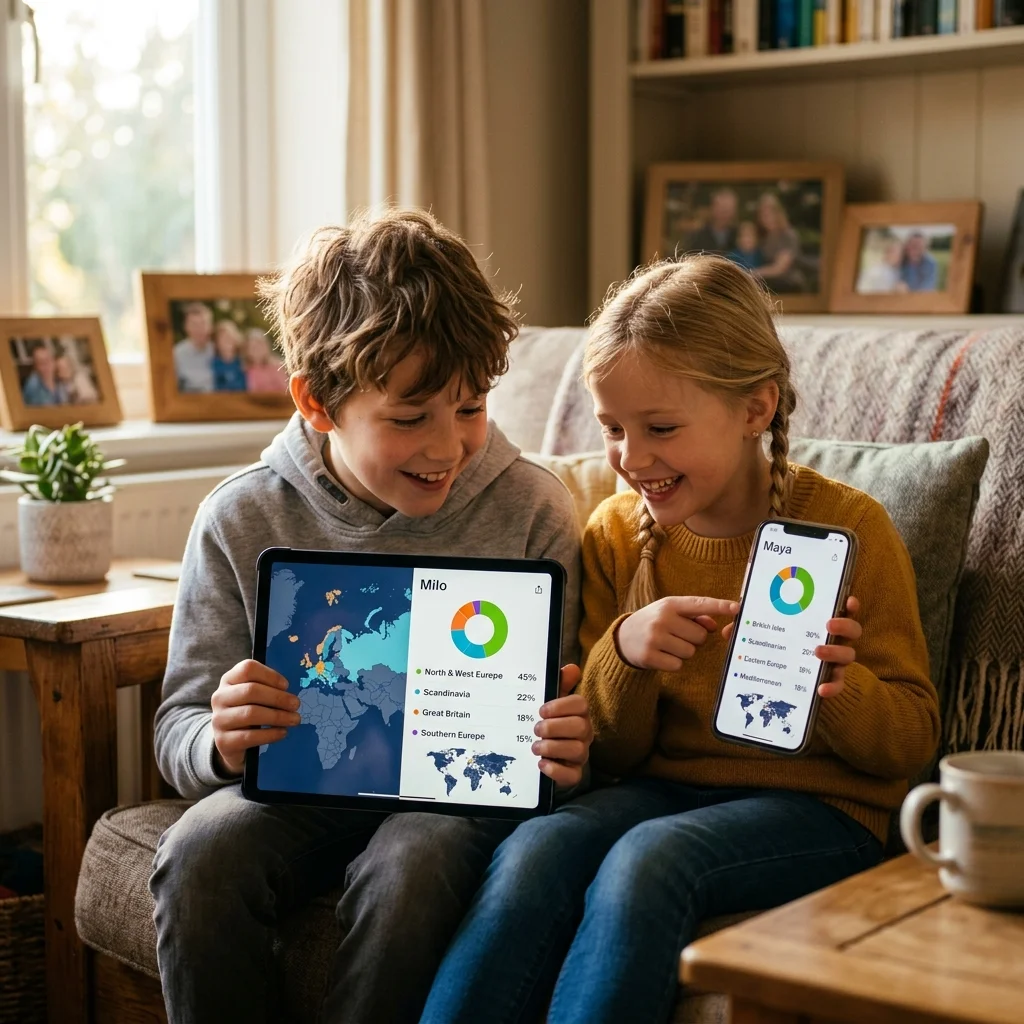
Two siblings take an ancestry DNA test.
One receives:
- 42% Irish
- 25% Germanic Europe
- 18% Scandinavian
- 15% Southern European
The other gets:
- 31% Irish
- 37% Germanic Europe
- 8% Scandinavian
- 24% Southern European
Same parents. Same grandparents. Same family history.
So how can their ancestry DNA results be different?
The short answer is simple:
Siblings inherit different combinations of DNA from the same parents.
Unless they are identical twins, brothers and sisters do not inherit exactly the same DNA. That means their ancestry percentages, DNA matches and even some visible family features can differ.
Do Siblings Have the Same DNA?
No.
Full siblings normally inherit approximately half of their DNA from their mother and half from their father.
But they do not necessarily inherit the same half.
Imagine your mother has two shuffled sets of genetic cards. Each child receives a different selection.
The same happens with DNA from your father.
As a result, two full siblings usually share a substantial amount of DNA, but their genetic profiles are not identical.
This process is one reason why siblings look different.
Why Can Siblings Have Different Ethnicity Percentages?
Ancestry testing companies examine parts of your DNA and compare them with reference populations.
Those comparisons produce an ethnicity or ancestral-region estimate.
Because siblings inherit different DNA segments, one sibling may inherit more segments associated with a particular region than another.
For example, imagine a parent has ancestry connected with both Ireland and Southern Italy.
One child might inherit more of the DNA segments currently associated with Irish reference populations.
Another child could inherit more segments that the testing company associates with Southern Italy.
Both children have exactly the same family tree.
But their DNA inheritance is different.
Example: Same Family, Different DNA Results
Imagine that two siblings have:
- an Irish grandmother;
- an Italian grandfather;
- a German grandmother;
- a Polish grandfather.
It may seem logical to expect exactly:
- 25% Irish
- 25% Italian
- 25% German
- 25% Polish
for every child.
Real genetic inheritance does not work so neatly.
DNA is recombined before being passed to the next generation.
One sibling could therefore receive an estimate such as:
- 31% Irish
- 18% Italian
- 29% Germanic Europe
- 22% Eastern European
while another receives:
- 19% Irish
- 30% Italian
- 24% Germanic Europe
- 27% Eastern European
Their family history did not change.
Their inherited genetic combination did.
Does a Different Percentage Mean One Sibling Is “More” of an Ethnicity?
Not necessarily.
This is one of the easiest ancestry results to misunderstand.
Suppose one sibling receives 27% Italian and another gets 18% Italian.
That does not mean the first sibling has more Italian ancestors.
They have the same grandparents, great-grandparents and family history.
The difference reflects the DNA segments each sibling inherited and how the testing company currently classifies those segments.
Ethnicity percentages should therefore be treated as estimates of genetic similarity, not exact measurements of identity. Read our detailed guide to learn what ancestry DNA percentages mean.
Can One Sibling Have an Ethnicity That the Other Does Not?
Yes.
This can be especially noticeable with smaller percentages.
For example:
Sibling A:
- 47% Irish
- 32% Germanic Europe
- 15% Italian
- 6% Scandinavian
Sibling B:
- 44% Irish
- 35% Germanic Europe
- 21% Italian
The second sibling may have no Scandinavian category at all.
That does not automatically mean the first result is wrong.
Several things can cause this difference:
- random DNA inheritance;
- small DNA segments;
- similarities between neighboring populations;
- different confidence thresholds;
- the testing company's reference populations;
- changes to ancestry algorithms.
Smaller percentages should usually be interpreted more cautiously than large, consistent ancestry patterns. Read our guide on why your DNA shows an ethnicity you don't know about to learn how unexpected regions appear.
Can Siblings Have Different DNA Matches?
Yes.
This can be one of the most useful reasons for multiple siblings to test.
Because siblings do not inherit exactly the same DNA, a distant cousin may share enough DNA with one sibling to appear as a match but share little enough with another sibling that the match is weaker or absent.
Close family relationships are much more likely to appear for both siblings.
Differences become particularly useful when researching more distant branches of a family tree.
One sibling's DNA matches can sometimes reveal relatives that another sibling's results do not show clearly. This is especially helpful when determining which parent did my ancestry come from.
Do Identical Twins Get the Same Ancestry Results?
Identical twins are a special case because they originate from the same fertilized egg and have extremely similar genetic profiles.
Their DNA ancestry results should therefore be much more similar than results between regular siblings.
However, ethnicity-estimate interfaces can still change because ancestry percentages are statistical classifications produced by a testing company's algorithm. Learn more about why ancestry DNA results differ.
The important distinction is that regular full siblings inherit different DNA combinations.
Why Can Siblings Look Like Different Sides of the Family?
The same principle can also appear visually.
One sibling might strongly resemble their mother's side.
Another could look much more like their father or even a grandparent.
You might notice differences in:
- face shape;
- eyes;
- jawline;
- nose;
- hair;
- pigmentation;
- facial proportions.
Visible appearance and ancestry percentages are not the same thing, but both are influenced by inheritance.
That is why one sibling may be told, “You look exactly like your Irish grandmother,” while another sibling is constantly compared with an Italian grandfather.
Can Your Face Match a Smaller DNA Percentage?
Sometimes your appearance may remind people of a family branch that represents only a relatively small percentage of your DNA ancestry estimate.
That does not mean your face is measuring DNA percentages.
Visible traits are inherited through complex combinations and do not appear proportionally according to an ethnicity report.
For example, being reported as:
- 50% Region A
- 30% Region B
- 20% Region C
does not mean your face must look 50% like Region A.
A relatively small family branch can sometimes contribute features that happen to be visually noticeable. For more on this topic, read: do I look like my DNA results.
Compare Your Face With Your Family Roots
DNA testing answers one type of ancestry question. Your face can spark another: Which parts of my family heritage seem most visible in my appearance?
Ancestor Lens lets you explore visual similarities between your facial features and appearance patterns associated with different countries and regions. It is not a DNA test and cannot determine biological ethnicity. Instead, it offers a visual ancestry experience designed for curiosity and family exploration.
Explore your visual heritage with Ancestor Lens →


What Should You Compare Between Siblings?
If several people in your family have ancestry results, compare more than just the percentages.
Look at:
- major ancestry regions;
- smaller ancestry regions;
- DNA matches;
- maternal and paternal branches;
- grandparents' known birthplaces;
- migration history;
- family photographs;
- documented family-tree evidence.
You may discover that different siblings preserve different clues from the same family story.
Frequently Asked Questions
Can full siblings have different ancestry DNA results?
Yes. Full siblings usually inherit different combinations of DNA from the same parents, so their ancestry percentages do not need to be identical.
Why does my sister have an ethnicity that I don't?
She may have inherited DNA segments associated with that population that you did not inherit, or the difference may involve a small or uncertain ancestry estimate.
Do siblings inherit exactly 50% of the same DNA?
No. Each child receives approximately half of their DNA from each parent, but different siblings do not normally receive the same half.
Can siblings have different DNA matches?
Yes. Because siblings inherit different DNA segments, particularly distant relatives may match one sibling more strongly than another.
Does a higher ethnicity percentage mean my sibling has more ancestors from that country?
No. Full siblings have the same biological family tree. Different percentages reflect genetic inheritance and the way the testing service interprets that DNA.
Can siblings look like different ethnic backgrounds?
People may perceive siblings differently because each sibling can inherit a different combination of visible traits. Appearance cannot prove ethnicity or nationality.
Final Thoughts
If you and your sibling receive different ancestry DNA percentages, the results are not automatically contradictory.
You share the same family tree.
But you do not inherit exactly the same genetic combination.
That is why siblings can have:
- different ethnicity percentages;
- slightly different ancestry regions;
- different distant DNA matches;
- different visible family traits.
Instead of asking which sibling has the “correct” ancestry, use both sets of results as complementary clues.
Together with family records, DNA matches, photographs and genealogy research, they can reveal a much richer picture of your family's history. Browse our collection of ancestry and DNA guides to learn more.
Begin My Ancestry Journey
Start exploring your visual heritage with Ancestor Lens. Upload a photo and discover which countries your face visually resembles — no DNA required.