Quick answer
You inherit exactly half of your autosomal DNA from each parent. The expected share from one grandparent is about 25%, from one great-grandparent about 12.5%, and from one great-great-grandparent about 6.25%. Except for the parent-child split, these are averages—not guaranteed amounts. Recombination shuffles DNA every generation, so the contribution from a particular ancestor can be higher, lower or eventually undetectable.
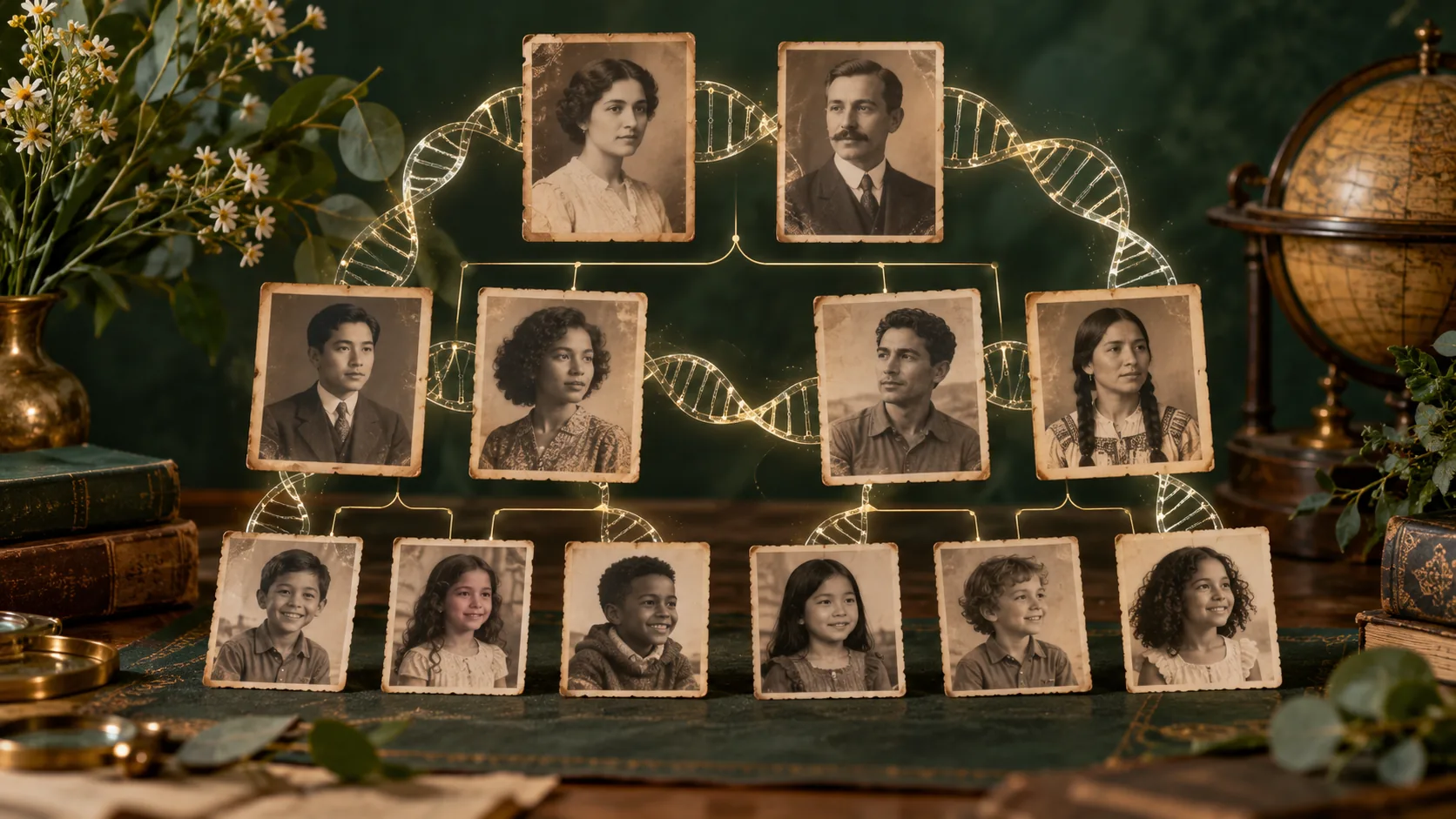
DNA inheritance percentage chart by generation
The expected contribution from a single direct ancestor is calculated by dividing by two for each generation. At the same time, the number of possible ancestors doubles: two parents, four grandparents, eight great-grandparents and so on.
| Direct ancestor | Generations back | Number at that generation | Expected DNA from one |
|---|---|---|---|
| Parent | 1 | 2 | 50% |
| Grandparent | 2 | 4 | 25% on average |
| Great-grandparent | 3 | 8 | 12.5% on average |
| 2× great-grandparent | 4 | 16 | 6.25% on average |
| 3× great-grandparent | 5 | 32 | 3.125% on average |
| 4× great-grandparent | 6 | 64 | 1.5625% on average |
| 5× great-grandparent | 7 | 128 | 0.78125% on average |
This chart is useful for understanding the family-tree math, but it is not a promise that a DNA test will show those exact figures. It also describes DNA inherited from a person, not the ethnicity percentage assigned by a testing company. Those are different measurements.
Why you do not get exactly 25% from every grandparent
Your mother passes half of her autosomal DNA to you, and your father passes the other half. Before that DNA is passed on, paired chromosomes exchange segments in a process called recombination. The result is a new mosaic of DNA from the previous generation.
This is why the two grandparents on one side contribute roughly 50% together, but not necessarily 25% each. One child may inherit a larger share from a maternal grandmother and a smaller share from a maternal grandfather. A sibling receives a different shuffled set. The same process explains why siblings can receive different ancestry results despite having the same parents.
Average does not mean exact
The 25%, 12.5% and 6.25% figures are statistical expectations across inheritance paths. The farther back an ancestor lived, the wider the possible variation and the greater the chance that you inherited no identifiable autosomal segment from that particular person.
Autosomal DNA, mitochondrial DNA and Y-DNA follow different paths
The chart above describes autosomal DNA—the chromosomes most consumer ancestry tests use for broad matching and ethnicity estimates. Mitochondrial DNA follows a direct maternal line. Y-DNA generally follows a direct paternal line and is available only to people with a Y chromosome. These line-specific tests can reach far back along one narrow branch, while autosomal DNA represents many recent branches.
How many generations back is 1% DNA?
If inheritance were perfectly even, 1% would fall between a 4× great-grandparent at 1.5625% and a 5× great-grandparent at 0.78125%—roughly six to seven generations back. In practice, a 1% ethnicity estimate cannot identify one specific ancestor by itself.
A small percentage might represent DNA from one ancestor, several ancestors with similar backgrounds, statistical uncertainty at the edge of a reference population, or a category that changes after an algorithm update. Modern populations also overlap geographically. Treat 1% as a research clue, then compare it with DNA matches and documentary evidence. Our guide to what ancestry DNA percentages mean explains how companies produce those estimates.
Why ethnicity percentages are not a family-tree calculator
An ethnicity estimate compares selected parts of your DNA with reference groups. It does not label every segment with the name of a known ancestor. If several branches came from neighboring populations, their inherited segments may be grouped under the same region. Conversely, one ancestor's DNA can be divided among nearby categories.
Genealogical ancestors vs genetic ancestors
A genealogical ancestor is anyone in your documented line of descent. A genetic ancestor is someone from whom you inherited a detectable DNA segment. Recent direct ancestors are usually both. Farther back, the categories begin to separate because your number of genealogical ancestors grows faster than the limited number of DNA segments that can survive recombination.
That distinction does not erase a relationship. You can be a documented descendant of a person without carrying an identifiable autosomal segment from them. Family history also includes names, places, language, migration, community and tradition—evidence that DNA alone cannot reconstruct.
How to interpret inherited DNA responsibly
- Start with the relationship type. Parent-child sharing is different from an ethnicity estimate or a distant match.
- Use ranges for relatives. Shared DNA between relatives varies because inheritance is random.
- Check both sides of the family. Known relatives can help assign matches and regions to maternal or paternal branches.
- Build a sourced tree. Birth, marriage, census, immigration and other records connect genetic clues to named people.
- Revisit small estimates. A minor region that persists across updates and appears in relatives is stronger evidence than a single isolated result.
If you are still mapping which branch contributed a region, read how to trace ancestry to your mother's or father's side. To understand how far evidence remains useful, see how far back ancestry DNA can reach.
Frequently asked questions
Do you get exactly 50% of your DNA from each parent?
For autosomal DNA, yes: one chromosome in each pair comes from your mother and the other from your father. The ancestral mix inside each parental half is shuffled, so you do not necessarily receive half of every ethnicity category shown in a parent's report.
Can you inherit more DNA from one grandparent?
Yes. You receive about 50% from each parent, but that parental half is a recombined mixture of the parent's two parents. The average from one grandparent is 25%, while an individual's actual share can differ.
How much DNA comes from a great-grandparent?
The expected share from one great-grandparent is 12.5%. The actual amount can be higher or lower because the relevant chromosome segments are randomly recombined across generations.
Can you have an ancestor whose DNA does not appear in your test?
Yes. As generations pass, some direct genealogical ancestors leave no detectable autosomal segment in a particular descendant. Records can still document that relationship even when DNA cannot.
Does 1% ethnicity equal one 5× great-grandparent?
No. That is only a rough mathematical comparison. An ethnicity estimate can combine contributions from multiple branches and includes uncertainty from the testing company's reference groups and model.
Sources and further reading
- National Library of Medicine: What is ancestry?
- MedlinePlus Genetics: What is genetic ancestry testing?
- The Tech Interactive: How much DNA do you inherit from each grandparent?
This article is educational and is not medical or legal advice. Consumer ancestry estimates should be interpreted alongside documented family history.

